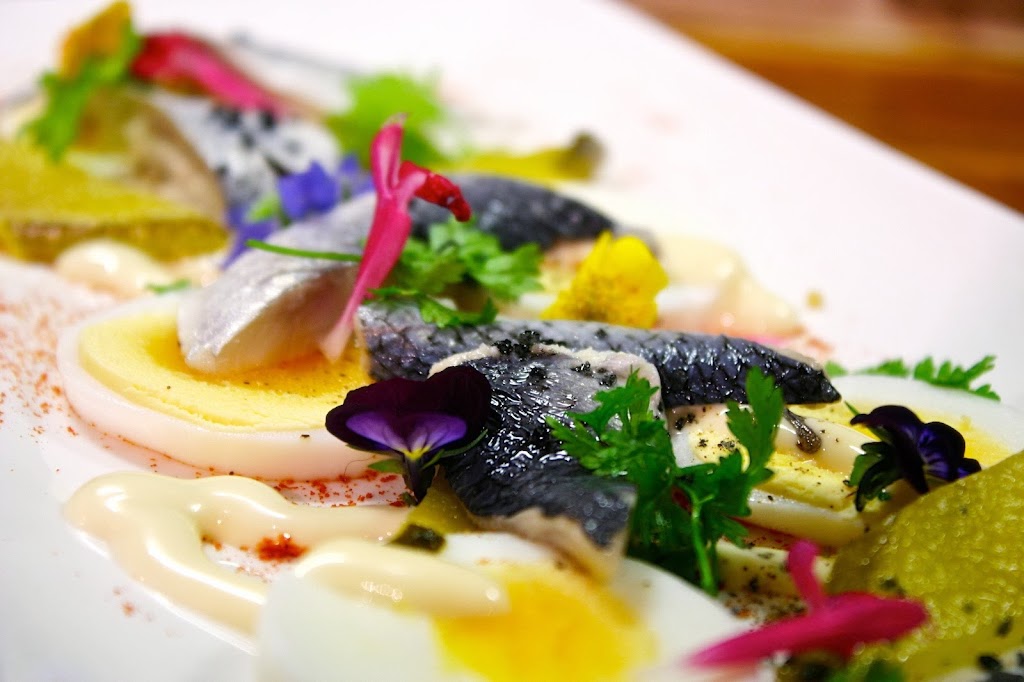
... as a starter.
You can figure it out - it's herring, egg, paprika, black pepper, Icelandic ash salt, Salad Cream, pickled gherkin and edible flowers.
EAT MOAR HERRING!
Showing posts with label nordic. Show all posts
30/10/2013
22/09/2013
Sprats [Nordic]
Following on from yesterday's breakfast, I still have some sprats left.
Today, Nordic.
Ingredients
Sprats. No sprats? Anchovies would be good, small sardines, small herrings or whitebait would do.
Potatoes, carrot, beetroot, onion, garlic, chilli, black pepper, sea salt, goose fat and spinach. Marjoram to cook, parsley to garnish.
Yoghurt, dill and lemon juice.
Hash
Dice up the roots, sautéing off the potatoes and carrots in your favourite paleo fat - goose fat, for me. Add the beetroot in later.
Give the skillet a good grind of black pepper, a pinch of sea salt and a sprinkle of dried marjoram. Oregano would do fine.
Continue to sauté over a medium heat until the roots are starting to soften, which might be around 10 minutes. Add in the beetroot at this point.
Add a chopped onion, sliced garlic and a couple of chillies, shredded.
Sauté on until soft, which might take another 20 minutes, or so.
Lay a generous handful of spinach per person into the skillet and let it wilt.
Meanwhile, a sauce ...
Sauce
Per person, a couple of heaped tablespoons of your favourite yoghurt and a generous amount of chopped dill. Good squeeze of lemon juice and stir together.
Use whatever yoghurt you like. Greek, regular cow, perhaps goat, sheep, even. I used a gorgeous sheep yoghurt from Dorset, here in the UK.
Now the sprats ...
Sprats
Eat them whole. Heads, tails, guts, the lot. Eat them whole.
If you're at all queasy about heads, cut them off. Actually, from there you can gut the fish by squeezing the belly up to where the head was. The guts will come out. Wash and you're done.
Otherwise, just make a small incision behind the gills and squeeze the belly up to the head to draw the guts.
Or, leave them in ... it's all good flavour!
You can pan-fry sprats or you can grill them. I prefer the grill. You say tomato, I say tomato. I'm British, and a grill for me is an overhead heat source: broiler, salamander.
Pan frying can be quite violent, leaving your sprats broken up and the fats over-cooked. Grill 'em. Lay your sprats out on a piece of kitchen foil and place under the grill on high. Two or three minutes each side is perfect.
Timing is less important than how they look - the skins should be just bubbling. Watch the fish, not the clock.
Serve
Fold the wilted spinach through the hash and plate up.
Sauce over, then the sprats. More black pepper, perhaps some more sea salt, certainly some flat leaf parsley to garnish.
I popped a couple of figs alongside ... a boiled egg would be equally good.
Today, Nordic.
Ingredients
Sprats. No sprats? Anchovies would be good, small sardines, small herrings or whitebait would do.
Potatoes, carrot, beetroot, onion, garlic, chilli, black pepper, sea salt, goose fat and spinach. Marjoram to cook, parsley to garnish.
Yoghurt, dill and lemon juice.
Hash
Dice up the roots, sautéing off the potatoes and carrots in your favourite paleo fat - goose fat, for me. Add the beetroot in later.
Give the skillet a good grind of black pepper, a pinch of sea salt and a sprinkle of dried marjoram. Oregano would do fine.
Continue to sauté over a medium heat until the roots are starting to soften, which might be around 10 minutes. Add in the beetroot at this point.
Add a chopped onion, sliced garlic and a couple of chillies, shredded.
Sauté on until soft, which might take another 20 minutes, or so.
Lay a generous handful of spinach per person into the skillet and let it wilt.
Meanwhile, a sauce ...
Sauce
Per person, a couple of heaped tablespoons of your favourite yoghurt and a generous amount of chopped dill. Good squeeze of lemon juice and stir together.
Use whatever yoghurt you like. Greek, regular cow, perhaps goat, sheep, even. I used a gorgeous sheep yoghurt from Dorset, here in the UK.
Now the sprats ...
Sprats
Eat them whole. Heads, tails, guts, the lot. Eat them whole.
If you're at all queasy about heads, cut them off. Actually, from there you can gut the fish by squeezing the belly up to where the head was. The guts will come out. Wash and you're done.
Otherwise, just make a small incision behind the gills and squeeze the belly up to the head to draw the guts.
Or, leave them in ... it's all good flavour!
You can pan-fry sprats or you can grill them. I prefer the grill. You say tomato, I say tomato. I'm British, and a grill for me is an overhead heat source: broiler, salamander.
Pan frying can be quite violent, leaving your sprats broken up and the fats over-cooked. Grill 'em. Lay your sprats out on a piece of kitchen foil and place under the grill on high. Two or three minutes each side is perfect.
Timing is less important than how they look - the skins should be just bubbling. Watch the fish, not the clock.
Serve
Fold the wilted spinach through the hash and plate up.
Sauce over, then the sprats. More black pepper, perhaps some more sea salt, certainly some flat leaf parsley to garnish.
I popped a couple of figs alongside ... a boiled egg would be equally good.
![]() |
| Sprats over beetroot hash with yoghurt dill sauce. |
11/07/2013
Nordic Pickled Beetroot Starter [Quick & Dirty]
Pickled beetroot is really cool!
Whether packed or in jars, pickled is such a fun way of enjoying beetroot.
I like both, but jars of pickled beetroot offer us a fun way of presenting eggs once the beetroot has all been eaten. Simply boil a couple of eggs and pickle them overnight in the remaining coloured vinegar, topped up with water if necessary. Next day, you'll have purple eggs!
That's an aside ...
Here, the eggs were simply boiled, sliced and presented on a plate with sliced pickled beetroot.
Crème fraîche over, sprigs of dill to garnish and black pepper, icelandic ash salt and some paprika for texture and colour.
þar! Nordic Pickled Beetroot ... a perfect, simple starter idea.
Whether packed or in jars, pickled is such a fun way of enjoying beetroot.
I like both, but jars of pickled beetroot offer us a fun way of presenting eggs once the beetroot has all been eaten. Simply boil a couple of eggs and pickle them overnight in the remaining coloured vinegar, topped up with water if necessary. Next day, you'll have purple eggs!
That's an aside ...
Here, the eggs were simply boiled, sliced and presented on a plate with sliced pickled beetroot.
Crème fraîche over, sprigs of dill to garnish and black pepper, icelandic ash salt and some paprika for texture and colour.
þar! Nordic Pickled Beetroot ... a perfect, simple starter idea.
26/02/2013
Nordic Reindeer Soup
... straight copy of my Icelandic Sheep Soup, but with reindeer meat and swede instead of the potato, so perhaps just that little bit more paleo purist-friendly.
Same drill ...
Begin by browning off some diced meat, add an onion, roughly chopped, some leek, some garlic and top up with stock and herbs: thyme and rosemary. Let it stew for a good couple of hours before adding in cubed swede and carrot to cook through for a further hour.
Serve out with salt and black pepper, and a garnish of fresh parsley.
Same drill ...
Begin by browning off some diced meat, add an onion, roughly chopped, some leek, some garlic and top up with stock and herbs: thyme and rosemary. Let it stew for a good couple of hours before adding in cubed swede and carrot to cook through for a further hour.
Serve out with salt and black pepper, and a garnish of fresh parsley.
24/02/2013
Colours of Iceland ... or, Pan-fried Salmon, Daikon, Cucumber and Asparagus with Purée
Actually, pan fried smoked salmon over garlic crushed potatoes with daikon cream, daikon cake and a purée of greens with asparagus and macerated cucumber!
We've just had a wonderful little break away to Iceland and I wanted to cook something to round off that trip and remind us of some of the colours and the flavours.
I had gorgeous couple of pieces of smoked salmon fillet in, which is perfect as the centre piece of the meal. I also had some daikon that needed using up ... that got me thinking about snow.
Rooting through the cupboards I found a few other things and a meal plan formed in my mind* ...
This is one of those meals that you prepare all the parts of the meal up front and put it all together at the end. Each part also used up all the trimmings and offcuts somehow, so pay attention to each step and don't throw anything away!
Get the cucumber macerating ...
Peel and slice some cucumber, reserving the skin for another part of the dish: the purée The slices should be thin. Pour over a couple of caps of white wine vinegar and toss in some finely chopped dill having removed the thick stalks. Again, reserve the stalks for the purée.
Take a few spears of asparagus and chop the tips off, reserving the stalk for the purée. Boil the tips briefly and add to the macerating vinegar.
Chop up a lot of dill really finely. This will be the covering garnish for the fish. Again, remove the thick stalks which should be reserved for the purée.
We also need just a little onion flavour, for which a spring onion is perfect. Slice off the white parts, reserving the greens for the purée and drop the white parts into the macerating vinegar.
Purée was mentioned a lot there, so let's make it ...
Collect all the green trimmings, chop up well, drop into a pan with a little butter and sauté through before pouring on some water. Some, not a huge amount. We're going to blend, sieve and reduce later, so the more water you add now, the more you'll have to reduce later on. Add a little sea salt in, too. Again, not too much since we'll be reducing and compounding the flavour.
After a few minutes of boiling, blend together to a really fine purée and pass through a sieve. Return the liquid to the pan and set to reduce.
Prepare the daikon ...
Daikon has a great radish flavour, perfect for partnering with the soft sweetness of the salmon.
Take your daikon, peel it and cut good thick slices straight through. One per person. Trim the edges to make a soft cake. Chop up all the trimmings and the rest of the daikon - this will be the daikon cream.
Boil the lot, retrieving the cakes for later. We'll colour these up in butter at the end.
Blend the rest of the daikon and add some mascarpone. Cream cheese, creme fraiche, even cream will do fine. My initial idea was to make quenelles and present as a sort of ice cream on top of the daikon cake.
You can do this by popping the mixture in the freezer and bringing it out once hardened, forming quenelles at the last minute. I didn't have enough time, so it went on the plate as a second purée.
Ready to eat?
All the faff is now done, so all that is left to do is boil the potatoes and pan fry the salmon, and daikon.
Set some salad potatoes boiling and just when they're about done, put the salmon in the hob in a skillet with some melted butter and, in another skillet, butter and the daikon cakes to colour up.
Pan fry the salmon on one side for two to three minutes, flip over and same on the other side. After another two or three minutes, remove from the hob and allow the residual heat just to cook it through while you plate up.
Your purée should now be fully reduced.
Potatoes done, crush them with a fork using the residual heat to melt a little butter in and cook a clove of minced garlic through. Black pepper. Just a grind.
Plate up ...
Potatoes in the middle, daikon cream one side, green purée the other. Daikon cake on top of the cream, or, if you've done the freezer thing, form quenelles of the cream and gently place on top of the cake.
Lay the salmon over the potato.
Drain off the cucumber, laying pieces around the plate along with the spring onions. Place the asparagus tips over the green puree and garnish: chopped dill over the salmon, Icelandic ash salt over the daikon.
Lovely contrasts, both in colour and flavour.
*Now you see it ... snow with ash, green moss and the salmon with a surf of potatoes.
The colours of Iceland on a plate ...
... or am I perhaps a little unhinged?
We've just had a wonderful little break away to Iceland and I wanted to cook something to round off that trip and remind us of some of the colours and the flavours.
I had gorgeous couple of pieces of smoked salmon fillet in, which is perfect as the centre piece of the meal. I also had some daikon that needed using up ... that got me thinking about snow.
Rooting through the cupboards I found a few other things and a meal plan formed in my mind* ...
This is one of those meals that you prepare all the parts of the meal up front and put it all together at the end. Each part also used up all the trimmings and offcuts somehow, so pay attention to each step and don't throw anything away!
Get the cucumber macerating ...
Peel and slice some cucumber, reserving the skin for another part of the dish: the purée The slices should be thin. Pour over a couple of caps of white wine vinegar and toss in some finely chopped dill having removed the thick stalks. Again, reserve the stalks for the purée.
Take a few spears of asparagus and chop the tips off, reserving the stalk for the purée. Boil the tips briefly and add to the macerating vinegar.
Chop up a lot of dill really finely. This will be the covering garnish for the fish. Again, remove the thick stalks which should be reserved for the purée.
We also need just a little onion flavour, for which a spring onion is perfect. Slice off the white parts, reserving the greens for the purée and drop the white parts into the macerating vinegar.
Purée was mentioned a lot there, so let's make it ...
Collect all the green trimmings, chop up well, drop into a pan with a little butter and sauté through before pouring on some water. Some, not a huge amount. We're going to blend, sieve and reduce later, so the more water you add now, the more you'll have to reduce later on. Add a little sea salt in, too. Again, not too much since we'll be reducing and compounding the flavour.
After a few minutes of boiling, blend together to a really fine purée and pass through a sieve. Return the liquid to the pan and set to reduce.
Prepare the daikon ...
Daikon has a great radish flavour, perfect for partnering with the soft sweetness of the salmon.
Take your daikon, peel it and cut good thick slices straight through. One per person. Trim the edges to make a soft cake. Chop up all the trimmings and the rest of the daikon - this will be the daikon cream.
Boil the lot, retrieving the cakes for later. We'll colour these up in butter at the end.
Blend the rest of the daikon and add some mascarpone. Cream cheese, creme fraiche, even cream will do fine. My initial idea was to make quenelles and present as a sort of ice cream on top of the daikon cake.
You can do this by popping the mixture in the freezer and bringing it out once hardened, forming quenelles at the last minute. I didn't have enough time, so it went on the plate as a second purée.
Ready to eat?
All the faff is now done, so all that is left to do is boil the potatoes and pan fry the salmon, and daikon.
Set some salad potatoes boiling and just when they're about done, put the salmon in the hob in a skillet with some melted butter and, in another skillet, butter and the daikon cakes to colour up.
Pan fry the salmon on one side for two to three minutes, flip over and same on the other side. After another two or three minutes, remove from the hob and allow the residual heat just to cook it through while you plate up.
Your purée should now be fully reduced.
Potatoes done, crush them with a fork using the residual heat to melt a little butter in and cook a clove of minced garlic through. Black pepper. Just a grind.
Plate up ...
Potatoes in the middle, daikon cream one side, green purée the other. Daikon cake on top of the cream, or, if you've done the freezer thing, form quenelles of the cream and gently place on top of the cake.
Lay the salmon over the potato.
Drain off the cucumber, laying pieces around the plate along with the spring onions. Place the asparagus tips over the green puree and garnish: chopped dill over the salmon, Icelandic ash salt over the daikon.
Lovely contrasts, both in colour and flavour.
*Now you see it ... snow with ash, green moss and the salmon with a surf of potatoes.
The colours of Iceland on a plate ...
... or am I perhaps a little unhinged?
23/02/2013
Open Nordic Sandwich
The open sandwich can be found across Europe and Scandinavia, each nation bringing its own variation, but nowhere is it more celebrated than in Denmark where is it practically an institution.
The open sandwich, or open-faced sandwich, is a simple slice of bread topped with meat or fish, sometimes pâté, eggs, pickles and salad.
Originating perhaps as early as the 6th Century (according to Wiki) but certainly during the Middle Ages, the bread was in place of a plate and the food layed over, the bread eaten at the end.
As paleo eaters, we don't eat bread. I could have made up a loaf of nut/seed bread or even just gone for a less problematic slice of rye bread, but it's just as much fun to remove the bread altogether ... we have plates, afterall.
While many open-faced sandwiches are quite simple, based around one or two ingredients, I decided to go to the other extreme, to the quite ridiculous and load everything I could think of onto a plate. Actually, I was inspired by such a similar creation that I ate in Stockholm airport only a few days before.
So, your open-faced sandwich can be anything you want ... meat or fish, perhaps pâté, eggs, pickles and salad.
I went with some nice lettuce at each side of a rectangular plate.
Next, some smoked salmon and prawns in stripes.
Fill in the gaps with boiled egg, sliced, pickled beetroot, pickled gherkin, tomato, cucumber and pink grapefruit segments! Yes, pink grapefruit, a perfect accompaniment to smoked salmon.
Poke a few cubes of chicken liver pâté in and garnish with dill, lots of dill.
Yum!
The open sandwich, or open-faced sandwich, is a simple slice of bread topped with meat or fish, sometimes pâté, eggs, pickles and salad.
Originating perhaps as early as the 6th Century (according to Wiki) but certainly during the Middle Ages, the bread was in place of a plate and the food layed over, the bread eaten at the end.
As paleo eaters, we don't eat bread. I could have made up a loaf of nut/seed bread or even just gone for a less problematic slice of rye bread, but it's just as much fun to remove the bread altogether ... we have plates, afterall.
While many open-faced sandwiches are quite simple, based around one or two ingredients, I decided to go to the other extreme, to the quite ridiculous and load everything I could think of onto a plate. Actually, I was inspired by such a similar creation that I ate in Stockholm airport only a few days before.
So, your open-faced sandwich can be anything you want ... meat or fish, perhaps pâté, eggs, pickles and salad.
I went with some nice lettuce at each side of a rectangular plate.
Next, some smoked salmon and prawns in stripes.
Fill in the gaps with boiled egg, sliced, pickled beetroot, pickled gherkin, tomato, cucumber and pink grapefruit segments! Yes, pink grapefruit, a perfect accompaniment to smoked salmon.
Poke a few cubes of chicken liver pâté in and garnish with dill, lots of dill.
Yum!
Kjötsúpa ... Icelandic Sheep Soup
Kjötsúpa is a traditional Icelandic dish of sheep, onion and root vegetables fortified with brown rice, barley or more traditionally, rolled oats.
Reading around the topic, many people claim that the dish must have this ... or must have that ... for authenticity. Many dishes the world over are like that.
I had some at a simple café in Reykjavik and got all I needed to know about this warming, comforting homely dish.
From a paleo perspective, we should leave the grain out. More purist paleo eaters can happily leave the potato out.
For a purist paleo Kjötsúpa, begin by browning off some diced lamb, add an onion, roughly chopped, some garlic and top up with stock and herbs: thyme and rosemary. Let it stew for a good couple of hours before adding in cubed swede and carrot to cook through. Serve out with salt and black pepper, and a garnish of fresh parsley.
For a paleo+ Kjötsúpa, begin by browning off some diced lamb, add an onion (I went with half an onion and some leek), roughly chopped, some garlic and top up with stock and herbs: thyme and rosemary. Let it stew for a good couple of hours before adding in cubed potato and carrot to cook through. Serve out with salt and black pepper, and a garnish of fresh parsley.
This is what I did.
Next time, I'll take the inspiration and go with another Nordic meat: reindeer, simmered with swede and carrot.
On serving ...
Some Icelanders serve out the meat and roots onto a plate, the cooking liquor accompanying in a mug alongside. If you want to serve out this way, make the cubes of vegetables a little larger at around an inch square. When serving as soup, dice the vegetables a little smaller, say, to half an inch square.
One final thing ...
Sheep on Iceland outnumber humans by almost 2:1 - there are around half a million sheep on Iceland to around 230,000 people. It is also said that these sheep are the descendants of the original herds brought to the island by the first settlers, a fact that I find amazing.
Reading around the topic, many people claim that the dish must have this ... or must have that ... for authenticity. Many dishes the world over are like that.
I had some at a simple café in Reykjavik and got all I needed to know about this warming, comforting homely dish.
From a paleo perspective, we should leave the grain out. More purist paleo eaters can happily leave the potato out.
For a purist paleo Kjötsúpa, begin by browning off some diced lamb, add an onion, roughly chopped, some garlic and top up with stock and herbs: thyme and rosemary. Let it stew for a good couple of hours before adding in cubed swede and carrot to cook through. Serve out with salt and black pepper, and a garnish of fresh parsley.
For a paleo+ Kjötsúpa, begin by browning off some diced lamb, add an onion (I went with half an onion and some leek), roughly chopped, some garlic and top up with stock and herbs: thyme and rosemary. Let it stew for a good couple of hours before adding in cubed potato and carrot to cook through. Serve out with salt and black pepper, and a garnish of fresh parsley.
This is what I did.
Next time, I'll take the inspiration and go with another Nordic meat: reindeer, simmered with swede and carrot.
On serving ...
Some Icelanders serve out the meat and roots onto a plate, the cooking liquor accompanying in a mug alongside. If you want to serve out this way, make the cubes of vegetables a little larger at around an inch square. When serving as soup, dice the vegetables a little smaller, say, to half an inch square.
One final thing ...
Sheep on Iceland outnumber humans by almost 2:1 - there are around half a million sheep on Iceland to around 230,000 people. It is also said that these sheep are the descendants of the original herds brought to the island by the first settlers, a fact that I find amazing.
22/02/2013
Fire & Ice ... or, Scallops with Chilli & Icelandic Ash Salt
While in Iceland (the country, not the shop ... before everyone goes en masse down to that frozen food retailer and winds up disappointed), I picked up some black salt.
"Icelandic flake salt from the Saltverk Reyjaness in the Icelandic Westfjords has a fantastic crispy crunch, clean mild flavour and good aftertaste.
The black colour comes from activated charcoal, resembling the Icelandic black lava and referring to the use of environmentally friendly geothermal energy in the drying process." http://www.urta.is
Want a closer look?
Upon returning to Britain, we went food shopping and I could not resist some really gorgeous looking plump and fresh scallops.
How to dress them up, though? Really good scallops need little more than flash frying in butter and eating ...
... but, we were having an evening of spicy Mexican-inspired food and it really should tie-in somehow. Easy! Chilies, lime juice and a garnish of coriander. Perfect for the fire! Icelandic salt sprinkled over for the ice.
The black, green and white we'd enjoyed some much as the landscape of Iceland.
"Icelandic flake salt from the Saltverk Reyjaness in the Icelandic Westfjords has a fantastic crispy crunch, clean mild flavour and good aftertaste.
The black colour comes from activated charcoal, resembling the Icelandic black lava and referring to the use of environmentally friendly geothermal energy in the drying process." http://www.urta.is
Want a closer look?
Icelandic Black Lava Salt
Upon returning to Britain, we went food shopping and I could not resist some really gorgeous looking plump and fresh scallops.
How to dress them up, though? Really good scallops need little more than flash frying in butter and eating ...
... but, we were having an evening of spicy Mexican-inspired food and it really should tie-in somehow. Easy! Chilies, lime juice and a garnish of coriander. Perfect for the fire! Icelandic salt sprinkled over for the ice.
The black, green and white we'd enjoyed some much as the landscape of Iceland.
21/02/2013
Iceland, Nordic and ... OMG! How good is whale?
Fuck all this shit!*
I'm going Nordic.
Apologies ... no, I don't apologise ... I don't apologise for the passion.
I've just had a few wonderful days up in Iceland. I am so invigorated, changed, fired up, inspired ... whatever the phrase.
I'm into a new approach and I am so excited.
Living in the Ice Age just got Nordic ... proper Nordic! Actually, quite Celtic.
Hold onto your teeth! There's a Viking punch coming!
* Not all of it - it will still be ancestral in focus and paleo for the most part. I won't be extolling the virtues of muesli and rye bread just yet!
I'm going Nordic.
Apologies ... no, I don't apologise ... I don't apologise for the passion.
I've just had a few wonderful days up in Iceland. I am so invigorated, changed, fired up, inspired ... whatever the phrase.
I'm into a new approach and I am so excited.
Living in the Ice Age just got Nordic ... proper Nordic! Actually, quite Celtic.
Hold onto your teeth! There's a Viking punch coming!
* Not all of it - it will still be ancestral in focus and paleo for the most part. I won't be extolling the virtues of muesli and rye bread just yet!
09/01/2013
Swedish Salmon Stew
I love reading cook books, rarely following any of the methods or even recipes, but I get a lot of inspiration - the reason I don't post with the traditional recipe and method combination is, I hope to inspire, not to instruct.
So, this 'ere stew ... how?
We're going to drop all manner of seafood goodies into a broth of vegetables.
The order is, veggies, salmon, shellfish, spices, finally, cream ...
First, the veggies ...
In a wide skillet, get some chopped onions softening in a little butter.
Make up a fish stock however it is that you do. I reserve all manner of heads and tail to boil up and keep a reduced stock in the freezer. I say that, but this time, it was a stock cube. Pour the stock into the skillet.
Slice some carrot and potato, get them boiling in the stock.
Once softened, add in some peas and asparagus.
Now, the seafood ...
Drop in whatever you want, but certainly salmon - a good fillet cut into large cubes. I got a wonderful piece of salmon just before Christmas and it's been sitting in my freezer waiting for a meal like this.
I also had some mussels, scallops and prawns, so these went in along with the salmon.
Watch the dish! We don't want things over-cooking, so once the salmon has gone fully opaque and just started to open, it's time to finish up the dish.
Finally, the spice and cream ...
Sprinkle over some turmeric and ground coriander, along with some black pepper. Ensure that the spices are combined.
The stock will, by now, be quite reduced and concentrated. Pour in a little full fat cream just go opaque. Cream helps to offset saltiness and lend a deep, sumptuous and warming character to the stew.
28/11/2012
Baltic Salad
Just a quick starter ...
Pickled herring, caviar, tomato, radish, gherkin, dill and leftover celeriac purée. That's about it!
I was pleased to find that celeriac purée goes so well with caviar. It's just missing an egg ... which I boiled and then forgot about, damn it!
Pickled herring, caviar, tomato, radish, gherkin, dill and leftover celeriac purée. That's about it!
I was pleased to find that celeriac purée goes so well with caviar. It's just missing an egg ... which I boiled and then forgot about, damn it!
14/11/2012
Prawn & Enoki Chowder
Just a quick and easy starter ...
Shred some onion or leek and soften in some butter in a skillet.
Cube some root veggies, tossing them in the butter and get them boiling in bouillon (or chicken stock, fish stock or other light stock) to soften.
Once softened, toss in some prawns, enoki mushrooms and something green - I went with green beans. Relax! They're all pod.
Pour in some cream and reduce.
Serve out, garnished with dill.
Shred some onion or leek and soften in some butter in a skillet.
Cube some root veggies, tossing them in the butter and get them boiling in bouillon (or chicken stock, fish stock or other light stock) to soften.
Once softened, toss in some prawns, enoki mushrooms and something green - I went with green beans. Relax! They're all pod.
Pour in some cream and reduce.
Serve out, garnished with dill.
15/10/2012
Scandinavian Herring Salad
I've travelled a lot around Scandinavia, the Baltic and out to Russia ... one thing that I always take home is the food!
I just seem to thrive on their cleaner, simpler version of what is very much British food, just done cleaner and simpler.
This salad is based around things you can find in your local supermarket.
Pickled herring, pickled beetroot, pickled gherkin, red onion, fennel, radish and dill. Eggs.
That's the ingredient list ... here's how ...
Shave some fennel. Use a veg peeler or a very sharp knife, but get some shavings of fennel and pop them on the plate.
Cut a couple of slices of red onion and immerse them in water - this will take the sting off them. After a good ten minutes, drain, collect the best bits, slice into reasonable sections and scatter over the plate.
Place a few pieces of pickled herring over, slices of radish, pickled gherkin and quarters of pickled beetroot.
Garnish with dill.
Slosh some olive oil over if you like ... I did. I also had a grind of black pepper over.
I just seem to thrive on their cleaner, simpler version of what is very much British food, just done cleaner and simpler.
This salad is based around things you can find in your local supermarket.
Pickled herring, pickled beetroot, pickled gherkin, red onion, fennel, radish and dill. Eggs.
That's the ingredient list ... here's how ...
Shave some fennel. Use a veg peeler or a very sharp knife, but get some shavings of fennel and pop them on the plate.
Cut a couple of slices of red onion and immerse them in water - this will take the sting off them. After a good ten minutes, drain, collect the best bits, slice into reasonable sections and scatter over the plate.
Place a few pieces of pickled herring over, slices of radish, pickled gherkin and quarters of pickled beetroot.
Garnish with dill.
Slosh some olive oil over if you like ... I did. I also had a grind of black pepper over.
24/05/2012
Pollock & Prawn Crepes
Swedish? I like to think so ... this is something very similar to a dish I've eaten in Sweden, most likely crayfish tails, but any good fish and shellfish will do just fine.
First, you need to make some crepes ... there, that was easy enough.
The rest of the dish comes together quickly, so get the family assembled ...
Chop up some pollock, toss it a few times in a skillet with some coconut oil and add a chopped onion in. No garlic - garlic and cream is not brilliant.
Next, toss in some prawns - the smaller the better, in my opinion, so shrimp would work out well. We might have a language difficulty there because I gather folks in the US call the things we Brits call prawns, shrimp. We think of shrimp as very small, brown things, prawns as medium to large pink things.
Whatever language of manner of shellfish you have, bung it in! Scallops would do well here; crayfish, perfect.
Add some fish stock and boil it down to about half. How much? Well, enough to cover, but not overpower once reduced. We're going to add some cream, so it's not critical ... if the dish ends up way too salty, a good squeeze of lemon should just balance it, but do that at the end.
Okay, liquour reduced, add in some cream and reduce further.
Just before serving, chop a good handful of dill and scatter in. Give it a good squeeze of lemon, too.
Spoon out of the fish into the crepes, fold over and enjoy.
First, you need to make some crepes ... there, that was easy enough.
The rest of the dish comes together quickly, so get the family assembled ...
Chop up some pollock, toss it a few times in a skillet with some coconut oil and add a chopped onion in. No garlic - garlic and cream is not brilliant.
Next, toss in some prawns - the smaller the better, in my opinion, so shrimp would work out well. We might have a language difficulty there because I gather folks in the US call the things we Brits call prawns, shrimp. We think of shrimp as very small, brown things, prawns as medium to large pink things.
Whatever language of manner of shellfish you have, bung it in! Scallops would do well here; crayfish, perfect.
Add some fish stock and boil it down to about half. How much? Well, enough to cover, but not overpower once reduced. We're going to add some cream, so it's not critical ... if the dish ends up way too salty, a good squeeze of lemon should just balance it, but do that at the end.
Okay, liquour reduced, add in some cream and reduce further.
Just before serving, chop a good handful of dill and scatter in. Give it a good squeeze of lemon, too.
Spoon out of the fish into the crepes, fold over and enjoy.
26/04/2012
Beef Lindström
Russo-Swedish. Resembling a hamburger but with the sweet taste of beetroot countered with the saltiness of capers. One great recipe to combine meat and pickled vegetables.
Introduced in Sweden in 1862 by Henrik Lindström, born in Saint Petersburg and raised in a Swedish family, it was while visiting a hotel restaurant in the Swedish city of Kalmar that Lindström instructed the kitchen on how to make his special fried beef patty. From there, the recipe spread all over Sweden.
In miniature format, this beetroot patty is a delicacy that is part of the classic Swedish smörgåsbord.
To the kitchen, Chefs ...
You need some mashed potato in this, so get one cubed and boiling away. I actually used two, since I was making some potato croutons to accompany and wanted them all regularly square, so all the trimmings from two potatoes made the mash.
Don't forget to retrieve the cubes after a few minutes - we don't want these to be too soft and will be frying them off later.
If white potato is not part of your paleo diet, you could use all manner of other root vegetables but do allow all the steam to evaporate the liquid. It might also be worth adding in a teaspoon, or two, or another starch - arrowroot, manioc, yam, that kind of thing. It's the starchiness in the potato which helps bind these and give a soft middle texture.
Meanwhile, drop a pound of minced beef into a mixing bowl. That's ground beef to some. Add a small amount of pork mince, too - maybe a quarter of a pound.
Finely chop an onion and then break it down further by shredding it. Scatter into the mixing bowl.
Mince some capers. Scatter into the mixing bowl.
Mince some pickled beetroot and scatter into the mixing bowl. Three golf ball sized beets will do perfectly.
Crack a couple of large eggs and retrieve the yolks, adding into the bowl. Reserve the whites for making up a mega-egg for breakfast.
Add in some sea salt and white pepper. I added in some shredded wild garlic, too, just because.
Your mashed potato should now have softened, so just mash it down and allow the steam to take off a lot of moisture. Add to the mixing bowl.
Now we get to the fun part, which should never be done with a food processor!
Roll your sleeves up and get your hands in there, squeezing the meat through your fingers. This action will break down the meat and ensure that everything is really well mixed together.
Fun, that!
Form a number of patties, somewhere between quarter and half pounders. You can make these flat or tall. I went for a bunch of tall patties.
Fry off over a medium heat in a little butter.
In another frying pan with some more butter or dripping, gently fry off the potato cubes to golden brown.
Ready to serve? Get a fried egg going while you plate up.
Place a patty in the middle of the plate, scattering pickled gherkin slices and the potato cubes around. Of course, you could accompany with some greens and some mashed sweet potato - that would be fantastic, too.
Slice the fried egg on top of the patty and dig in ...
Njuta!
Introduced in Sweden in 1862 by Henrik Lindström, born in Saint Petersburg and raised in a Swedish family, it was while visiting a hotel restaurant in the Swedish city of Kalmar that Lindström instructed the kitchen on how to make his special fried beef patty. From there, the recipe spread all over Sweden.
In miniature format, this beetroot patty is a delicacy that is part of the classic Swedish smörgåsbord.
To the kitchen, Chefs ...
You need some mashed potato in this, so get one cubed and boiling away. I actually used two, since I was making some potato croutons to accompany and wanted them all regularly square, so all the trimmings from two potatoes made the mash.
Don't forget to retrieve the cubes after a few minutes - we don't want these to be too soft and will be frying them off later.
If white potato is not part of your paleo diet, you could use all manner of other root vegetables but do allow all the steam to evaporate the liquid. It might also be worth adding in a teaspoon, or two, or another starch - arrowroot, manioc, yam, that kind of thing. It's the starchiness in the potato which helps bind these and give a soft middle texture.
Meanwhile, drop a pound of minced beef into a mixing bowl. That's ground beef to some. Add a small amount of pork mince, too - maybe a quarter of a pound.
Finely chop an onion and then break it down further by shredding it. Scatter into the mixing bowl.
Mince some capers. Scatter into the mixing bowl.
Mince some pickled beetroot and scatter into the mixing bowl. Three golf ball sized beets will do perfectly.
Crack a couple of large eggs and retrieve the yolks, adding into the bowl. Reserve the whites for making up a mega-egg for breakfast.
Add in some sea salt and white pepper. I added in some shredded wild garlic, too, just because.
Your mashed potato should now have softened, so just mash it down and allow the steam to take off a lot of moisture. Add to the mixing bowl.
Now we get to the fun part, which should never be done with a food processor!
Roll your sleeves up and get your hands in there, squeezing the meat through your fingers. This action will break down the meat and ensure that everything is really well mixed together.
Fun, that!
Form a number of patties, somewhere between quarter and half pounders. You can make these flat or tall. I went for a bunch of tall patties.
Fry off over a medium heat in a little butter.
In another frying pan with some more butter or dripping, gently fry off the potato cubes to golden brown.
Ready to serve? Get a fried egg going while you plate up.
Place a patty in the middle of the plate, scattering pickled gherkin slices and the potato cubes around. Of course, you could accompany with some greens and some mashed sweet potato - that would be fantastic, too.
Slice the fried egg on top of the patty and dig in ...
Njuta!
14/01/2012
Naked Baltic Salad!
Naked? No, you don't need to go au naturel to make this up ...
Simple to put together and a great punch of sour goodness!
Around the Baltic, all manner of pickles can be found as favourites in all states from Sweden to Russia to Poland and everywhere in between.
The list is not restrictive, but pickled herring, pickled anchovy, pickled gherkin, pickled beetroot, sauerkraut, pickled carrot and boiled eggs are all sound ingredients.
Take a few, some or all of these and put them on a plate.
Here, I went with a small bed of sauerkraut topped with a couple of pieces of pickled herring and a couple of slices of pickled gherkin alongside.
Accompanied by a blob of soured cream; more authentic to the Baltic is smetana which has a more creamier flavour than the soured cream we're used to in Western Europe, and garnished with dill.
Astonishingly, I had neither in the house, so the salad is naked!
Dress it if you're prudish :)
Simple to put together and a great punch of sour goodness!
Around the Baltic, all manner of pickles can be found as favourites in all states from Sweden to Russia to Poland and everywhere in between.
The list is not restrictive, but pickled herring, pickled anchovy, pickled gherkin, pickled beetroot, sauerkraut, pickled carrot and boiled eggs are all sound ingredients.
Take a few, some or all of these and put them on a plate.
Here, I went with a small bed of sauerkraut topped with a couple of pieces of pickled herring and a couple of slices of pickled gherkin alongside.
Accompanied by a blob of soured cream; more authentic to the Baltic is smetana which has a more creamier flavour than the soured cream we're used to in Western Europe, and garnished with dill.
Astonishingly, I had neither in the house, so the salad is naked!
Dress it if you're prudish :)
11/12/2011
Baltic Bi Bim Bap
I was introduced to Bi Bim Bap by the Perfect Health Diet blog: Bi Bim Bap - the food looked fresh, fun and flavoursome, and something I wanted to do for myself.
I had some fun making up a kind of British Bi Bim Bap and this morning set about making up a Baltic inspired version.
Using leftover Jansson's Temptation as the foundation stone, topped with a fried egg and all manner of Baltic ingredients can be built up around the edge.
I went for pickled herrings, smoked salmon, sausages, sauerkraut, radish, grated carrot, blueberries, pickled gherkin, pickled beetroot, soured cream and a little turmeric sprinkled over.
Huge fun!
What a seriously sound breakfast for an energetic day ahead.
I had some fun making up a kind of British Bi Bim Bap and this morning set about making up a Baltic inspired version.
Using leftover Jansson's Temptation as the foundation stone, topped with a fried egg and all manner of Baltic ingredients can be built up around the edge.
I went for pickled herrings, smoked salmon, sausages, sauerkraut, radish, grated carrot, blueberries, pickled gherkin, pickled beetroot, soured cream and a little turmeric sprinkled over.
Huge fun!
What a seriously sound breakfast for an energetic day ahead.
10/12/2011
Jansson's Temptation
The fat lowers the glycemic load of the potato and overall, it's a pretty perfect meal of fat, carbohydrate and protein.
If you're not down with the paleo+ areas of dairy and starches as part of your paleo lifestyle, there are plenty of other dishes here to inspire. If you are, read on.
Here's how it's done ...
Finely slice an onion and get it caramelising in some butter.
Shred up some potatoes into matchsticks and line an ovenproof dish.
Lay the onions over and then some anchovies.
Repeat and top up with cream, laying a final layer of potato on top.
Bake at 180C for 45-60 minutes, serve out with something like fish and kale. Done!
14/11/2011
Skånsk Kalops
Simple, easy and everyone already knows the recipe ...
Using braising steak, make up a beef stew with meat, onions, garlic, spice and stock. I peppered the stock with Cayenne pepper.
Simmer for a couple of hours.
Some recipes warrant carrot in a thicker and darker variation, and so I cubed up some butternut squash as something between carrot and potato.
Green beans can be stirred in a few minutes before serving.
Serve out into a bowl and scatter dill over.
... and don't forget sliced pickled beetroot in your haste to wolf it down. Oops!
Pyttipanna
Swedish for small pieces in the pan, similar to the British hodgepodge Bubble & Squeak, Pyttipanna is a thrifty meal of leftover meat, potatoes, fried and a fried egg on top.
Sounds great!
Let's keep it paleo ...
My little ode to the rustic Pyttipanna was a starter.
I had a lot of leftover beef from a Sunday roast and so thought to make up a little taster - a Pyttipanna in miniature.
I use some swede instead of potato and a poached quail egg to top.
Here's how ... this will work for a full dish, taster, starter, or whatever you want to make.
Take the leftover beef out of the fridge and cube up.
Traditionally, cube up some potato - waxy is best. Any root veg will do - swede, rutabaga, parsnip, carrot, whatever.
Soften some pastured butter in a frying pan, toss in some chopped onion and cook off the root veg. Pre-boil the veg for a few minutes if you like, but it's not necessary.
Toss in the meat and continue to fry until the meat and veg is coloured and cooked through.
Meanwhile, cube some pickled beetroot and pickled gherkin.
Slide the meat and veg onto a plate, toss over the beetroot and gherkin and then crack an egg into the frying juices. Lay the fried egg over - there, proper Pyttipanna.
Alternatively, made much smaller and more delicately, place a small amount of meat and veg in the middle of a plate and carefully place a few pieces of beetroot and gherkin around.
Meanwhile, boil up a pan of water and crack a couple of quail eggs in to poach. This takes literally seconds.
Retrieve the eggs, dry off and place over the Pyttipanna.
Dress with dill.
Sounds great!
Let's keep it paleo ...
My little ode to the rustic Pyttipanna was a starter.
I had a lot of leftover beef from a Sunday roast and so thought to make up a little taster - a Pyttipanna in miniature.
I use some swede instead of potato and a poached quail egg to top.
Here's how ... this will work for a full dish, taster, starter, or whatever you want to make.
Take the leftover beef out of the fridge and cube up.
Traditionally, cube up some potato - waxy is best. Any root veg will do - swede, rutabaga, parsnip, carrot, whatever.
Soften some pastured butter in a frying pan, toss in some chopped onion and cook off the root veg. Pre-boil the veg for a few minutes if you like, but it's not necessary.
Toss in the meat and continue to fry until the meat and veg is coloured and cooked through.
Slide the meat and veg onto a plate, toss over the beetroot and gherkin and then crack an egg into the frying juices. Lay the fried egg over - there, proper Pyttipanna.
Alternatively, made much smaller and more delicately, place a small amount of meat and veg in the middle of a plate and carefully place a few pieces of beetroot and gherkin around.
Meanwhile, boil up a pan of water and crack a couple of quail eggs in to poach. This takes literally seconds.
Retrieve the eggs, dry off and place over the Pyttipanna.
Dress with dill.
Subscribe to:
Posts
(
Atom
)
![Sprats [Nordic] Sprats [Nordic]](https://blogger.googleusercontent.com/img/b/R29vZ2xl/AVvXsEjS5ChyphenhyphenJ9VrnaKwMwepyFWrpNmq2XvvyhRz_c_yyiWH8V2tQTngQJg0MNZiu2w8cu2vv0g1mofGbCezDFOh-IFrL0yDQiY6XvKWFJZMP7NhDRc4UZSMzQLkPXw6KPWSX4KWrsdA/s320/IMG_2825%2520LR4.jpg)
![Sprats [Nordic] Sprats [Nordic]](https://blogger.googleusercontent.com/img/b/R29vZ2xl/AVvXsEj76BDzcoHuDzevhFXeI8igkPkVrnBKFg0UN2QLU6188dRcDgWazVvKLv9oc8VUh47ZMDW9-Z5gVc2vOZn6Y_wPk97Z24zPRJhIRgfMhKTnDVpBzwDG3z1Qzodzlwll0gh0ObYx/s320/IMG_2842%2520LR4.jpg)
