Showing posts with label comfort. Show all posts
11/11/2013
21/09/2013
Enchiladas Suizas ... Cheesefest!
Last time I made this, it was for Pancake Day ... you know, Fat Tuesday, Mardi Gras, whatever you call it. Anyway, it's been about six months and we really fancied a Saturday night treat.
Treeeeeeeat!
Method was exactly the same as before ...
Filling
I made a beef mince and prawn stuffing with cauli rice.
Back up! Minced beef and prawn? Yes! It works! Simply brown off some minced beef with chopped onion, garlic, chilli and ginger, a good splash of Worcestershire Sauce (which I am let to believe that Mexicans love as Salsa Anglais), some tomato purée and beef stock. Pour in some chopped tomato (not too much, say, half a carton to a pound of beef). Simmer on for a couple of hours. Pour in some small prawns which folks from the US might call shrimp. Steam some cauliflower florets, crush with a fork and stir into the meat - this is the rice.
Pancakes
Make up some manioc tortilla. Something like a cup of manioc flour to four eggs to half a cup of grated parmesan will do perfectly. I hate parmesan, so used pecorino, a hard sheep cheese. Manchego would do equally well. This will make about six to eight 6" tortilla, so adjust accordingly.
Likewise, a pound on mince, a cup of prawns and a reasonable cauliflower will fill those 6-8.
Go on ... roll 'em up!
Pico de Gallo
While these Enchiladas are gorgeous on their own, just a little Pico de Gallo perfects the dish.
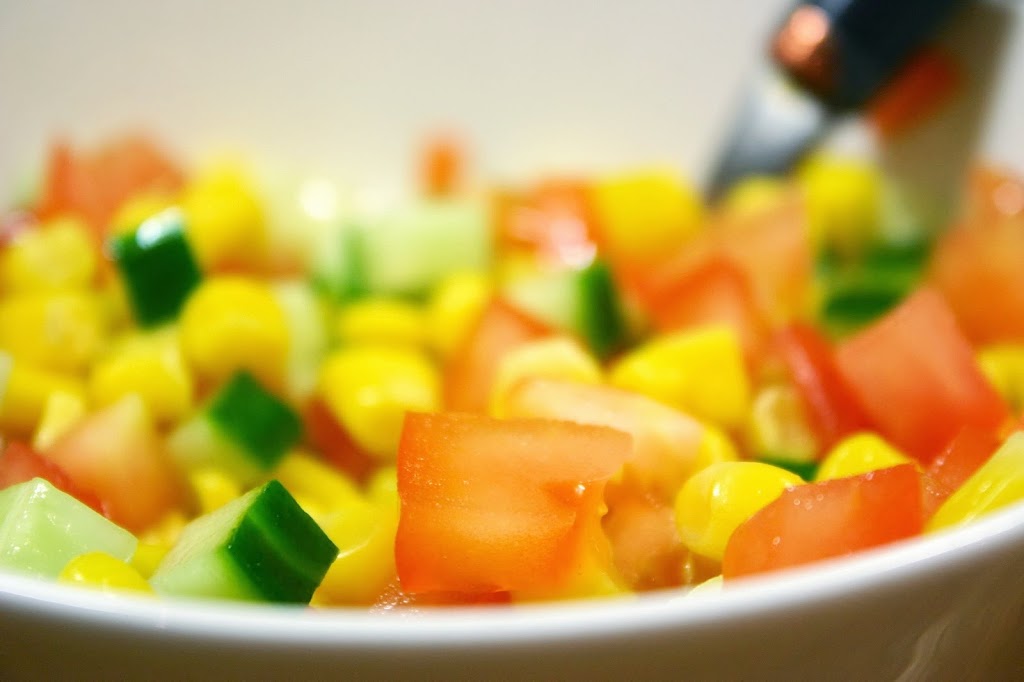
Simply chop up some tomato, cucumber, spring onions and add in some sweetcorn, omitting the later if it's not a part of your ancestral diet.
Serve
Collect the Enchiladas from the oven, serving a couple each and scattering the Pico de Gallo over.
Dig in and enjoy!
Treeeeeeeat!
Method was exactly the same as before ...
Filling
I made a beef mince and prawn stuffing with cauli rice.
Back up! Minced beef and prawn? Yes! It works! Simply brown off some minced beef with chopped onion, garlic, chilli and ginger, a good splash of Worcestershire Sauce (which I am let to believe that Mexicans love as Salsa Anglais), some tomato purée and beef stock. Pour in some chopped tomato (not too much, say, half a carton to a pound of beef). Simmer on for a couple of hours. Pour in some small prawns which folks from the US might call shrimp. Steam some cauliflower florets, crush with a fork and stir into the meat - this is the rice.
Pancakes
Make up some manioc tortilla. Something like a cup of manioc flour to four eggs to half a cup of grated parmesan will do perfectly. I hate parmesan, so used pecorino, a hard sheep cheese. Manchego would do equally well. This will make about six to eight 6" tortilla, so adjust accordingly.
Likewise, a pound on mince, a cup of prawns and a reasonable cauliflower will fill those 6-8.
Go on ... roll 'em up!
Roll up! Roll up!
Cheese Sauce
Now for the Swiss bit ...
Understand that we don't need much. No need to go all neolithic and drown this great food in cheese; just a little will do just fine. I used a blend of mature and medium cheddar. Some. I don't measure, so don't know how much, so "some" will have to do as my explanation.
Cheese, grated, melted in single cream. No need for flour. No need for thickener. If you get the cheese to cream right, it works. Grated the cheese, then on a low heat add as little cream as you think you will get away with and only add more if you cannot get the cheese to melt without going hard them moment the pan is lifted off the stove.
Pour the sauce over and pop it into the oven at 175C for about 15-20 minutes.
Meanwhile ...
Pico de Gallo
While these Enchiladas are gorgeous on their own, just a little Pico de Gallo perfects the dish.
Simply chop up some tomato, cucumber, spring onions and add in some sweetcorn, omitting the later if it's not a part of your ancestral diet.
Serve
Collect the Enchiladas from the oven, serving a couple each and scattering the Pico de Gallo over.
Dig in and enjoy!
20/08/2013
Steamed Cod & Parsley Sauce
Classic British ... and kept Primal!
This is definitely one for the lactose tolerant amongst us and some folks will take issue with my use of the word Primal, there, but I am in no doubt that it is - yes, it's dairy, milk even, but well sourced and not thickened with a traditional roux or cornflour.
Traditionally, you'd begin with a roux of flour and butter into which infused milk is poured.Flour is out, as is cornflour ... which would be added at the end. Arrowroot is right out since it lends a slimy texture to the sauce which is not appealing.
How, then? Here's how ...
Begin with good milk. Raw, preferably. I used some Jersey cow milk which is of the A2 type, less problematic than the potentially allergenic A1 type, even for those who are lactose tolerant.
Half a pint is good for two people - we are going to reduce this, but we're also going to add some cream at the end. Half a pint is good, in a saucepan ... into which we add half a chopped onion, some tarragon, a couple of bay leaves and some white pepper to flavour up the milk.
Simmer for about 10 minutes.
Strain off the solids and return to the pan to reduce along with a generous amount of chopped parsley. Don't do this too quickly, but after another 10 minutes, or so, simmering, the liquid will be visibly thicker.
Meanwhile, prepare and cook the meal through - it'll only need maybe 10 minutes anyway.
Fish - I went with cod, which can be steamed in a kitchen foil lined steamer. I have a stacking steamer set, so this goes up on top.
Veggies - carrot, potato and peas, all in the base pan to boil through with spring greens in a steamer on top. Cod in a steamer on top of that, remember.
10 minutes ...
If your sauce is still reducing, just turn the heat off under your veggies and fish - they'll keep warm.
With your sauce now well thickened, add a dash of double cream, perhaps some salt to taste and if really necessary, a touch of cassava flour will just thicken it perfectly. Cassava flour, tapioca flour or even potato flour will do, as a beurre manié.
There I go again with French phrases ... relax, it's just butter and flour mixed together into a paste, which is dropped into the sauce in chunks and whisked in until just right.
Serve out ...
Cod down, veggies alongside and sauce over the cod. Grind of freshly milled black pepper, grab your diggers and ... erm ... dig in! Perfect! Gorgeous comfort food, kept Primal.
This is definitely one for the lactose tolerant amongst us and some folks will take issue with my use of the word Primal, there, but I am in no doubt that it is - yes, it's dairy, milk even, but well sourced and not thickened with a traditional roux or cornflour.
Traditionally, you'd begin with a roux of flour and butter into which infused milk is poured.Flour is out, as is cornflour ... which would be added at the end. Arrowroot is right out since it lends a slimy texture to the sauce which is not appealing.
How, then? Here's how ...
Begin with good milk. Raw, preferably. I used some Jersey cow milk which is of the A2 type, less problematic than the potentially allergenic A1 type, even for those who are lactose tolerant.
Half a pint is good for two people - we are going to reduce this, but we're also going to add some cream at the end. Half a pint is good, in a saucepan ... into which we add half a chopped onion, some tarragon, a couple of bay leaves and some white pepper to flavour up the milk.
Simmer for about 10 minutes.
Strain off the solids and return to the pan to reduce along with a generous amount of chopped parsley. Don't do this too quickly, but after another 10 minutes, or so, simmering, the liquid will be visibly thicker.
Meanwhile, prepare and cook the meal through - it'll only need maybe 10 minutes anyway.
Fish - I went with cod, which can be steamed in a kitchen foil lined steamer. I have a stacking steamer set, so this goes up on top.
Veggies - carrot, potato and peas, all in the base pan to boil through with spring greens in a steamer on top. Cod in a steamer on top of that, remember.
10 minutes ...
If your sauce is still reducing, just turn the heat off under your veggies and fish - they'll keep warm.
With your sauce now well thickened, add a dash of double cream, perhaps some salt to taste and if really necessary, a touch of cassava flour will just thicken it perfectly. Cassava flour, tapioca flour or even potato flour will do, as a beurre manié.
There I go again with French phrases ... relax, it's just butter and flour mixed together into a paste, which is dropped into the sauce in chunks and whisked in until just right.
Serve out ...
Cod down, veggies alongside and sauce over the cod. Grind of freshly milled black pepper, grab your diggers and ... erm ... dig in! Perfect! Gorgeous comfort food, kept Primal.
23/05/2013
Turkey Mince 'No Taters' Cottage Pie
I'm not averse to potatoes, but looking back through some old recipes I was reminded just how good cauliflower mash is.
Doing things just a little differently, I decided to use turkey mince. Low fat, turkey mince gives us the opportunity to add in whatever fat we choose to - here, coconut oil.
Deviating further, I wanted a more spicy version.
Begin by browning off some turkey mince in coconut oil. One pound for two people is good.
While that's browning, dice up a medium onion and toss that in, stirring through.
Dice up some other veggies. I went with some aubergine (eggplant) and courgette (zucchini), sufficient to double the amount in the pan.
Now, the flavours ...
Garlic first, several cloves. Now, graze through your spice cupboard! I added in some ground coriander, ground cumin, black pepper, paprika, chilli powder and some powdered chicken stock.
Squirt in some tomato purée and stir through. The purée will help to thicken the dish as well as bring in some depth of flavour.
Allow that to cook through in the pan and pick up some toasted flavour. Don't let it stick!
Cover with water and simmer through until the liquid is well reduced.
The mash? Cauliflower ...
Take a cauli, trim the leaves off, core it and steam the florets. Once soft, allow the steam to evaporate off and mash it together with some cheddar cheese.
Transfer the meat sauce to an ovenproof dish and spoon the mash over. Bake at 180C for about 20 minutes.
You kept the cauli leaves didn't you? No? Shame on you! Yes? Great! Take the better ones, shred and steam them.
Serve out, Cottage Pie with shredded cauli greens alongside.
Doing things just a little differently, I decided to use turkey mince. Low fat, turkey mince gives us the opportunity to add in whatever fat we choose to - here, coconut oil.
Deviating further, I wanted a more spicy version.
Begin by browning off some turkey mince in coconut oil. One pound for two people is good.
While that's browning, dice up a medium onion and toss that in, stirring through.
Dice up some other veggies. I went with some aubergine (eggplant) and courgette (zucchini), sufficient to double the amount in the pan.
Now, the flavours ...
Garlic first, several cloves. Now, graze through your spice cupboard! I added in some ground coriander, ground cumin, black pepper, paprika, chilli powder and some powdered chicken stock.
Squirt in some tomato purée and stir through. The purée will help to thicken the dish as well as bring in some depth of flavour.
Allow that to cook through in the pan and pick up some toasted flavour. Don't let it stick!
Cover with water and simmer through until the liquid is well reduced.
The mash? Cauliflower ...
Take a cauli, trim the leaves off, core it and steam the florets. Once soft, allow the steam to evaporate off and mash it together with some cheddar cheese.
Transfer the meat sauce to an ovenproof dish and spoon the mash over. Bake at 180C for about 20 minutes.
You kept the cauli leaves didn't you? No? Shame on you! Yes? Great! Take the better ones, shred and steam them.
Serve out, Cottage Pie with shredded cauli greens alongside.
28/03/2013
Primal Mac & Cheese
Granted, this is really stretching the boundaries of primal eating, what with it being primarily a cheese and cream dish ... and one based around pasta, but please read on ...
Perhaps one for your vegetarian friends, or perhaps just for that 80/20 meal where you really don't fancy neolithic junk, but do want something simple, filling and ... well ... homely?
Mac & Cheese, I gather, is a dish at the heart of American cuisine. Sure, we have it here in Blighty, although call it Macaroni Cheese, but it's not something we'd immediately shout out when someone asks, "what's your favourite comfort food?".
So, why make it?
Well, I have a glut of cheese and a couple of turnips. Reason enough?
Primal Mac & Cheese
First we need the "Mac" ...
Here, I peel some turnip and then cut it into matchsticks about an inch long and perhaps a fifth of an inch square.
Boil for a few minutes until softened but still with just a little crunch, drain and set aside to allow the remaining steam to evaporate.
Now, the Cheese ...
You'll need cream (heavy cream, I think it's called in the United States) and some cheese. I used cheddar and a cheddar-like goat's cheese. How much? Well, probably just over half a cup of cream (say, 150ml) to 250g of cheese per apple-sized turnip. You can multiply that up.
Warm up the cream, add a dollop of English Mustard and then the cheese. Warm it through on a low heat until the cheese is combined and the sauce looks sumptuous. Yes, English Mustard, not grain, not American or Continental ... English ... it has the right bite without that sourness.
Now, pour the Mac into the Cheese ... Ecco! Mac & Cheese.
Want to primalise it more?
Shred some streaky bacon and leek, fry off together.
Meanwhile, steam some cauliflower, pouring the Mac & Cheese over the cauliflower and topping with the leek and bacon, and some chopped hazelnuts to crisp up under the grill (broiler) for a few minutes.
Neo-primal Heaven!
For another great emulation of neolithic comfort food, check out my Primal Lasagne.
Perhaps one for your vegetarian friends, or perhaps just for that 80/20 meal where you really don't fancy neolithic junk, but do want something simple, filling and ... well ... homely?
Mac & Cheese, I gather, is a dish at the heart of American cuisine. Sure, we have it here in Blighty, although call it Macaroni Cheese, but it's not something we'd immediately shout out when someone asks, "what's your favourite comfort food?".
So, why make it?
Well, I have a glut of cheese and a couple of turnips. Reason enough?
Primal Mac & Cheese
First we need the "Mac" ...
Here, I peel some turnip and then cut it into matchsticks about an inch long and perhaps a fifth of an inch square.
Boil for a few minutes until softened but still with just a little crunch, drain and set aside to allow the remaining steam to evaporate.
Now, the Cheese ...
You'll need cream (heavy cream, I think it's called in the United States) and some cheese. I used cheddar and a cheddar-like goat's cheese. How much? Well, probably just over half a cup of cream (say, 150ml) to 250g of cheese per apple-sized turnip. You can multiply that up.
Warm up the cream, add a dollop of English Mustard and then the cheese. Warm it through on a low heat until the cheese is combined and the sauce looks sumptuous. Yes, English Mustard, not grain, not American or Continental ... English ... it has the right bite without that sourness.
Now, pour the Mac into the Cheese ... Ecco! Mac & Cheese.
Want to primalise it more?
Shred some streaky bacon and leek, fry off together.
Meanwhile, steam some cauliflower, pouring the Mac & Cheese over the cauliflower and topping with the leek and bacon, and some chopped hazelnuts to crisp up under the grill (broiler) for a few minutes.
Neo-primal Heaven!
For another great emulation of neolithic comfort food, check out my Primal Lasagne.
11/03/2013
Halibut Steak & Coley Bake [Cold Comfort Farm]
Comfort food ...
Last night, our central heating system became possessed and started growling. This morning it began snarling, then went into a full on whining howl ... and then went dead silent.
Yeah, kippered fan which brings the lot to a halt.
So, tonight we're at the mercy of the elements in a stone house built in the 1820s and temperatures just below zero.
We have one halogen heater with one bar dead, two fan heaters (might as well sit around a match), but the star of the show is the solid fuel burner in the main room. It doesn't half heat up the house, chimney breast, so the bedroom is nice and toasty, downstairs is actually warmer than usual, but the other bedrooms, dining room and kitchen are freezing!
I swear ... it was warmer in Iceland!
Anyway, dinner, and we had a comfort dish ...
I made up a "bake" of Atlantic coley, leek, celery, mushroom, garlic, asparagus, cabbage, mashed potato, chive, cream and mature cheddar.
Folks looking for a recipe should understand that this was a "use up" dish made from whatever I had around. The focus for the bake is some tail-ends of coley fillets, diced; everything else was simply whatever I could pluck from the vegetable store.
So, that's the ingredients for the coley bake ... just warm it all through in a frying pan, tossed in goose fat.
Meanwhile, some potatoes are boiling away for mashing and a couple of eggs boiling.
Once mashed, fold in the rest of the ingredients and tip out into an ovenproof dish, more cheddar over the top, sea salt, black pepper, chopped hazelnut crumbs and re-bake in the oven.
Set a good handful of chopped kale steaming and fry off a couple of halibut steaks. This should take about 8-10 minutes.
Serve out with a good portion of the coley bake, alongside which the steamed kale and halibut steak can sit. Garish with the boiled egg.
Gorgeous!
Thank God for thermals, that's all I can say. So, should I carry on with cold thermogenesis and have an ice cold plunge bath this evening?
Last night, our central heating system became possessed and started growling. This morning it began snarling, then went into a full on whining howl ... and then went dead silent.
Yeah, kippered fan which brings the lot to a halt.
So, tonight we're at the mercy of the elements in a stone house built in the 1820s and temperatures just below zero.
We have one halogen heater with one bar dead, two fan heaters (might as well sit around a match), but the star of the show is the solid fuel burner in the main room. It doesn't half heat up the house, chimney breast, so the bedroom is nice and toasty, downstairs is actually warmer than usual, but the other bedrooms, dining room and kitchen are freezing!
I swear ... it was warmer in Iceland!
Anyway, dinner, and we had a comfort dish ...
I made up a "bake" of Atlantic coley, leek, celery, mushroom, garlic, asparagus, cabbage, mashed potato, chive, cream and mature cheddar.
Folks looking for a recipe should understand that this was a "use up" dish made from whatever I had around. The focus for the bake is some tail-ends of coley fillets, diced; everything else was simply whatever I could pluck from the vegetable store.
So, that's the ingredients for the coley bake ... just warm it all through in a frying pan, tossed in goose fat.
Meanwhile, some potatoes are boiling away for mashing and a couple of eggs boiling.
Once mashed, fold in the rest of the ingredients and tip out into an ovenproof dish, more cheddar over the top, sea salt, black pepper, chopped hazelnut crumbs and re-bake in the oven.
Set a good handful of chopped kale steaming and fry off a couple of halibut steaks. This should take about 8-10 minutes.
Serve out with a good portion of the coley bake, alongside which the steamed kale and halibut steak can sit. Garish with the boiled egg.
Gorgeous!
Thank God for thermals, that's all I can say. So, should I carry on with cold thermogenesis and have an ice cold plunge bath this evening?
12/02/2013
Pancake Day Enchiladas Suizas
Shrove Tuesday, Fat Tuesday, Mardi Gras, Pancake Day ...
Whatever you call it, we just had it and for dinner, we had a treat!
Enchiladas Suizas
From Wikipedia: "Suiza, or Swiss, is an adjective that indicates the dish is topped with a white, milk or cream-based sauce, such as Béchamel. This appellation is derived from Swiss immigrants to Mexico who established dairies to produce cream and cheese."
Fusion food - Swiss/Mexican? How cool!
We need something for the filling. I made a beef mince and prawn stuffing with cauli rice.
Back up! Minced beef and prawn? Yes! It works! Simply brown off some minced beef with chopped onion, garlic, chilli and ginger, a good splash of Worcestershire Sauce (which I am let to believe that Mexicans love as Salsa Anglais), some tomato purée and beef stock. Pour in some chopped tomato (not too much, say, half a carton to a pound of beef). Simmer on for a couple of hours. Pour in some small prawns which folks from the US might call shrimp. Steam some cauliflower florets, crush with a fork and stir into the meat - this is the rice.
Make up some manioc tortilla. Something like a cup of manioc flour to four eggs to half a cup of grated parmesan will do perfectly. I hate parmesan, so used pecorino, a hard sheep cheese. Manchego would do equally well. This will make about six to eight 6" tortilla, so adjust accordingly.
Likewise, a pound on mince, a cup of prawns and a reasonable cauliflower will fill those 6-8.
Ready to get busy?
Yes, inevitably, some of the filling falls out, so just heap it back up onto the plate. Fantastic flavours, textures and a superb dish!
Do you like the dish? That's a neolithic artefact!
Whatever you call it, we just had it and for dinner, we had a treat!
Enchiladas Suizas
From Wikipedia: "Suiza, or Swiss, is an adjective that indicates the dish is topped with a white, milk or cream-based sauce, such as Béchamel. This appellation is derived from Swiss immigrants to Mexico who established dairies to produce cream and cheese."
Fusion food - Swiss/Mexican? How cool!
We need something for the filling. I made a beef mince and prawn stuffing with cauli rice.
Back up! Minced beef and prawn? Yes! It works! Simply brown off some minced beef with chopped onion, garlic, chilli and ginger, a good splash of Worcestershire Sauce (which I am let to believe that Mexicans love as Salsa Anglais), some tomato purée and beef stock. Pour in some chopped tomato (not too much, say, half a carton to a pound of beef). Simmer on for a couple of hours. Pour in some small prawns which folks from the US might call shrimp. Steam some cauliflower florets, crush with a fork and stir into the meat - this is the rice.
Make up some manioc tortilla. Something like a cup of manioc flour to four eggs to half a cup of grated parmesan will do perfectly. I hate parmesan, so used pecorino, a hard sheep cheese. Manchego would do equally well. This will make about six to eight 6" tortilla, so adjust accordingly.
Likewise, a pound on mince, a cup of prawns and a reasonable cauliflower will fill those 6-8.
Ready to get busy?
Stuff the tortilla ...
... roll it up ...
... repeat ...
Now for the cheese sauce ...
Notice we don't need much. No need to go all neolithic and drown this great food in cheese; just a little will do just fine. I used a blend of mature and medium cheddar. Some. I don't measure, so don't know how much, so "some" will have to do as my explanation.
Cheese sauce ...
Cheese, grated, melted in single cream. No need for flour. No need for thickener. If you get the cheese to cream right, it works. Grated the cheese, then on a low heat add as little cream as you think you will get away with and only add more if you cannot get the cheese to melt without going hard them moment the pan is lifted off the stove.
... pour over ...
... into the oven at 175C for 15 minutes ...
... serve out!
Do you like the dish? That's a neolithic artefact!
19/01/2013
Primal Lasagne
It may surprise you to know that Lasagne is actually British! No, really ...
Mentioned as Loseyne in 'The Forme of Cury', a 14th Century English cook book, where the recipe is recorded as:
"Take gode broth and do in an erthen pot, take flour of payndemayn and make therof past with water. and make therof thynne foyles as paper with a roller, drye it harde and seeth it in broth take Chese ruayn grated and lay it in disshes with powdour douce. and lay theron loseyns isode as hoole as thou mizt and above powdour and chese, and so twyse or thryse, & serue it forth."
Easy ... so "sheets", cheese and something between them ...
Primal Lasagne!
Okay, so what the heck is primal about Lasagne, eh? Well, nothing, especially not since primal is most certainly not about emulating neolithic foods with alternative ingredients - that's just gluten-free.
Whenever I see recipes that emulate neolithic meals that are presented by simple placing the word "Paleo" or "Primal" up front, it gives me a smile - a smile is not a bad thing; a sneer is.
I smile. I smile because they do it, I do it, we all do it. To some extent, all so-called Primal cooking is quite neolithic in itself. Substituting ingredients that are negative to our health with ingredients which are not is eminently primal ... and a good thing to do.
Here's how not to do just that ...
Jump to about 43 minutes in for the substitution sketch
I hope you had a laugh ... L&H are quite probably the absolute genesis of film comedy. Whatever they do is funny ... everything after is a copy of these guys' comedy genius. Stanley is a northern Brit, don't you know.
Back to it ...
I also smile because this kind of food is quite often comfort food - it should make us smile. Tonight, cold, snowing and next to a warming fire, a plate of comforting Lasagne with a glass of nice Chilean Merlot is just the ticket.
We should take time to smile. I have read, although I am hazy about the reality of it, that when we smile, our brains release happiness into our system. It's a nice thought.
Let's get to it ...
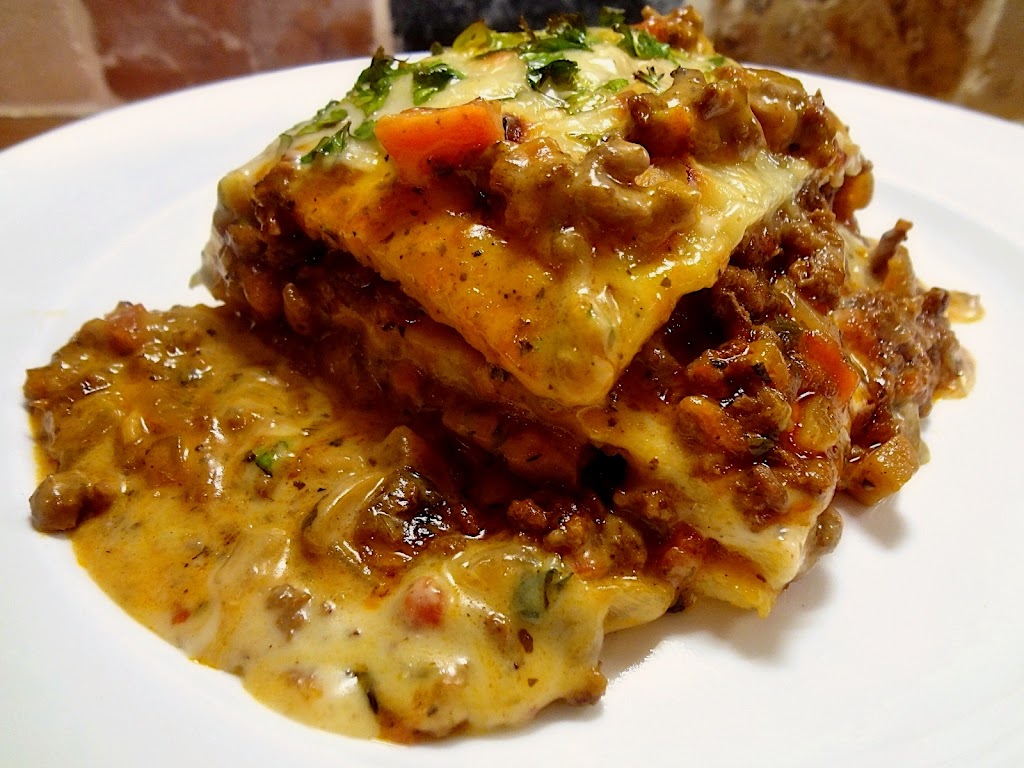
The filling is a simple ragu of minced beef, onion, garlic, celery, carrot and mushroom in a chopped tomato, puree and beef stock sauce. Slow-cooked for three hours, reduced, perfect!
The cheese sauce is cheddar - medium and mature, mixed, in a mixture of half cow cream and half goat milk. Reduce until thickened.
The "pasta" is a manioc pancake - a cup of manioc flour (Brazilian sour starch, as I buy it), half a cup of finely grated pecorino, a sheep cheese, four eggs and an inch off a stick of goat butter, melted. This made me three large (12") pancakes, nice and thick, too, so three layers in the lasagne ("thryse" in our Old English tongue).
You can make these up while the cheese sauce is reducing and thickening. Don't be tempted to use arrowroot in a dairy sauce - it will look disgusting!
Ready to put it together?
In a 12" square dish, some cheese sauce, some ragu, a pancake and then repeat two more times. More cheese sauce over the top and some fresh herbs. Pop it in the oven for about 15 minutes until crispy and brown on top, then serve out.
Of course, if you have a different shaped dish, perhaps oval, make smaller pancakes and put two side by side to fill the shape.
Better than pasta-based Lasagne? Not 'arf!
03/11/2012
Shepherd's Pie ... proper Shepherd's Pie
What's "proper" about it, then?
Well, it's made with mutton and it's not ground/minced ... it's a piece of shoulder.
Mutton is from older sheep with a strong, fully developed flavour lending itself perfectly to slow cooking and simple flavours.
Several hours earlier ...
In the morning, simply lay your mutton shoulder in a large casserole dish, cover with water, add some salt, pepper, garlic and a bay leaf.
Set it slow cooking for the day ... 125C/250F for as many hours as you can.
Hours later ...
Retrieve the mutton joint and chop up roughly. Save the stock for later, excess for soup, skimming off as much fat as you can, reserving it for frying off the onions and mushrooms, excess stored in a ramekin in the fridge for later.
Fry off an onion and a good few mushrooms - I find chestnut mushroom perfect with this.
Return the chopped mutton, onion and mushrooms to the casserole dish.
Chop a couple of carrots and add to the dish.
More garlic and some herbs - I went with rosemary and marjoram.
Cover with stock and add a good splash of Worcestershire Sauce, a good couple of tablespoons of tomato purée, a little sea salt and some black pepper.
Pop back into the oven at a higher temperate for an hour, or so. 180C/350F is good. Ensure that the juice evaporates and thickens - we don't want a sloppy pie!
After a good hour, toss in some peas. You can skip this if peas are not part of your paleo template - they're more pod than legume; I'm okay with them every now and again.
Take a cauliflower, remove the stalks saving them for soup, cut up removing as much stalk as you can and get it steaming.
Once steamed, crush with a fork.
With the casserole fully reduced, spoon the crushed cauliflower over making a crust. Scatter some grated cheese over and pop under the grill/broiler for a few minutes.
Again, if cheese is not part of your paleo template, just skip it. If it is, great! I went with Gruyère.
Serve out into a bowl, dig in and enjoy! Warming, filling and a seriously hearty dish ...
Well, it's made with mutton and it's not ground/minced ... it's a piece of shoulder.
Mutton is from older sheep with a strong, fully developed flavour lending itself perfectly to slow cooking and simple flavours.
Several hours earlier ...
In the morning, simply lay your mutton shoulder in a large casserole dish, cover with water, add some salt, pepper, garlic and a bay leaf.
Set it slow cooking for the day ... 125C/250F for as many hours as you can.
Hours later ...
Retrieve the mutton joint and chop up roughly. Save the stock for later, excess for soup, skimming off as much fat as you can, reserving it for frying off the onions and mushrooms, excess stored in a ramekin in the fridge for later.
Fry off an onion and a good few mushrooms - I find chestnut mushroom perfect with this.
Return the chopped mutton, onion and mushrooms to the casserole dish.
Chop a couple of carrots and add to the dish.
More garlic and some herbs - I went with rosemary and marjoram.
Cover with stock and add a good splash of Worcestershire Sauce, a good couple of tablespoons of tomato purée, a little sea salt and some black pepper.
Pop back into the oven at a higher temperate for an hour, or so. 180C/350F is good. Ensure that the juice evaporates and thickens - we don't want a sloppy pie!
After a good hour, toss in some peas. You can skip this if peas are not part of your paleo template - they're more pod than legume; I'm okay with them every now and again.
Take a cauliflower, remove the stalks saving them for soup, cut up removing as much stalk as you can and get it steaming.
Once steamed, crush with a fork.
With the casserole fully reduced, spoon the crushed cauliflower over making a crust. Scatter some grated cheese over and pop under the grill/broiler for a few minutes.
Again, if cheese is not part of your paleo template, just skip it. If it is, great! I went with Gruyère.
Serve out into a bowl, dig in and enjoy! Warming, filling and a seriously hearty dish ...
04/08/2012
Cauliflower Cheese
Paleo+ comfort food.
If dairy in the form of cheese and cream is not within your paleo template then move along ... there's plenty more here.
You could, of course, omit the dairy entirely and enjoy some tender steamed vegetables with bacon and shallot, and perhaps a drizzle of avocado oil and some chilli - there's a thought. Maybe next time.
Back to it ... we've a cheese sauce to make and that is something that is not an easy thing to do without flour, cornflour or some other thickener. You could use a starch, like arrowroot, but it tends to make the sauce look slimy.
Here's how ...
Get your vegetables steaming - a whole cauliflower and a whole broccoli taken off the stems is good for two people.
In a skillet, get some shredded bacon slices and shredded shallot warming through and crisping up. I scooped up some really nice outdoor reared, hung and smoked bacon in the end of date section at the supermarket for literally pence! Score!
The sauce ...
Grate about 300g of cheese. We use more cheese than usual here. I used a mature cheddar - full of flavour with a superb tang.
In a small milk pan over a gentle heat, melt some butter. How much? Well, enough. Maybe a half centimetre slice of the end of a stick?
Whisk that together with a little hot water - somewhere between a teaspoon and a tablespoon is fine. You're thinking that fat and water do not mix, but we can emulsify using a whisk. Why? We need a little liquid to go with our double cream, which is next.
Pour in about 100ml of double cream. You might call this heavy cream, depending upon where you live. You may just call it cream.
Stirred into the emulsified butter, you should now have a thinned out cream. This is much better than simply watering down cream and better than using milk.
Finally, dump in the cheese and keeping it low and slow ... just let the cheese melt in. Stir occasionally to ensure that it is not sticking.
Not thick enough? Pop in an egg yolk. Beat in quickly so that it does not scramble. In fact, drop in an egg yolk anyway for a really deep sauce.
Want something really special? Secret ingredient? English Mustard. Stir in a teaspoon of English Mustard and the sauce will pep up and go a gorgeous yellow. It must be English Mustard for the heat and bite - American, French or German will not do since it is too bitter.
So, that's our sauce done, our vegetables steamed and our crunchy topping done.
Spoon out the vegetables into an ovenproof dish, pour over the sauce and sprinkle the bacon and shallot over. Place it under the grill/broiler for a few minutes to really crispen up.
Serve out into wide brimmed bowls with a sprinkle of sea salt and a grind of freshly milled black pepper.
If dairy in the form of cheese and cream is not within your paleo template then move along ... there's plenty more here.
You could, of course, omit the dairy entirely and enjoy some tender steamed vegetables with bacon and shallot, and perhaps a drizzle of avocado oil and some chilli - there's a thought. Maybe next time.
Back to it ... we've a cheese sauce to make and that is something that is not an easy thing to do without flour, cornflour or some other thickener. You could use a starch, like arrowroot, but it tends to make the sauce look slimy.
Here's how ...
Get your vegetables steaming - a whole cauliflower and a whole broccoli taken off the stems is good for two people.
In a skillet, get some shredded bacon slices and shredded shallot warming through and crisping up. I scooped up some really nice outdoor reared, hung and smoked bacon in the end of date section at the supermarket for literally pence! Score!
The sauce ...
Grate about 300g of cheese. We use more cheese than usual here. I used a mature cheddar - full of flavour with a superb tang.
In a small milk pan over a gentle heat, melt some butter. How much? Well, enough. Maybe a half centimetre slice of the end of a stick?
Whisk that together with a little hot water - somewhere between a teaspoon and a tablespoon is fine. You're thinking that fat and water do not mix, but we can emulsify using a whisk. Why? We need a little liquid to go with our double cream, which is next.
Pour in about 100ml of double cream. You might call this heavy cream, depending upon where you live. You may just call it cream.
Stirred into the emulsified butter, you should now have a thinned out cream. This is much better than simply watering down cream and better than using milk.
Finally, dump in the cheese and keeping it low and slow ... just let the cheese melt in. Stir occasionally to ensure that it is not sticking.
Not thick enough? Pop in an egg yolk. Beat in quickly so that it does not scramble. In fact, drop in an egg yolk anyway for a really deep sauce.
Want something really special? Secret ingredient? English Mustard. Stir in a teaspoon of English Mustard and the sauce will pep up and go a gorgeous yellow. It must be English Mustard for the heat and bite - American, French or German will not do since it is too bitter.
So, that's our sauce done, our vegetables steamed and our crunchy topping done.
Spoon out the vegetables into an ovenproof dish, pour over the sauce and sprinkle the bacon and shallot over. Place it under the grill/broiler for a few minutes to really crispen up.
Serve out into wide brimmed bowls with a sprinkle of sea salt and a grind of freshly milled black pepper.
05/05/2012
Grok Donalds?
The irony is, prior to ancestral eating, eating at fast food restaurants was something I simply did not do, still don't, but there is a certain trend on paleo forums towards emulation ... which is not always a bad thing.
For a fun Saturday night meal, have a go at nuggets with a salad and fries ...
First, you need some pink slime.
I went for turkey mince, because it is pink and because I love it! This is a lean meat. Feel free to mince some chicken breast if you like - they're your nuggets.
I used just shy of a pound of meat with some spring onions, shredded, a couple of chillies, finely minced, sea salt, white pepper and an egg yolk. Squeeze between your fists a few times to soften, then pat it out flat. Half, half again (quarters) and half again (eighths) - each eighth will make a ball just larger than a golf ball. Form meatballs and squash gently.
Dust in something starchy - I used farina, a mashed potato flour.
Fry off in some coconut oil until coloured and transfer to the oven set to 200C for about 15 minutes.
Meanwhile, make up the salad - Caesar Salad.
Named after restaurateur Caesar Cardini, Caesar Salad is a simple affair of romaine lettuce and croutons with a sauce of parmesan cheese, egg yolk and lemon juice.
Using cubes of feta in place of croutons and embellishing with tomato, cucumber, olives and capers, we have a really sound paleo salad.
The sauce? Grate some parmesan, add an egg yolk, some lemon juice, a little cider vinegar, maybe some English mustard, sea salt, white pepper and stir it all together well. You should have an emulsion to spoon over the salad.
No such meal would be complete without fries, would it?
I appreciate that potato in the paleo diet is controversial and open to much discussion, so do this according to your dietary principles - sweet potato, rutabaga, celeriac, or any number of roots will work perfectly well here.
Fries represent a huge pack of carbohydrate and fat energy with a potentially high glycemic load ... unless they're eaten with fat. Simply put, fat slows the digestive process dramatically lowering the glycemic load. Want to know more? Check out J Stanton's article on Fat and the Glycemic Index: The Myth of Complex Carbohydrates.
What you fry your potatoes in is vitally important - saturated fats are the best! I wrote up an entire article about fries, or (skinny) chips as we call them in the UK: Chips!
Fry off your fries in dripping for a golden colour and full flavour, duck fat if you're doing it all continental.
Finally, you will need a condiment: tomato ketchup or barbecue sauce.
Easy to make - take some tomato puree and flavour with a gastrique of cider vinegar and honey, some salt and a touch of arrowroot in lemon juice. Ensure that the ingredients are thoroughly combined in a blender.
Honey? Honey is more than sweetener - natural and loaded with complex medicinal effects ranging from immunity boosters to anti-cancer and anti-microbial properties. It passes the hunger/gatherer principle. The honey I used is local (very local, like a mile or so away) from Denholme Gate Apiary.
Arrowroot? It's just a starchy thickener. Don't fret.
Don't like the idea of either? Don't put them in. Fancy Stevia instead? Well, it's a banned food in Europe, so out of my recipe, but feel free. I don't know enough about Stevia, having never tried it, but think that a chemically extracted powder is not really within the spirit of paleo. Agave syrup might well do the trick.
You could buy a primal-friendly ketchup - Tiptree brand is pretty good, organic and hand-produced. Actually, Heinz now make an organic version of their ketchup which uses tomatoes grown free from pesticides and contains no MSG or HFCS! It's a strong step in the right direction, Heinz!
Ready to eat?
Lay the warm nuggets over the salad with the fries alongside and a ramekin of condiment.
Dig in, fingers only!
For a fun Saturday night meal, have a go at nuggets with a salad and fries ...
First, you need some pink slime.
I went for turkey mince, because it is pink and because I love it! This is a lean meat. Feel free to mince some chicken breast if you like - they're your nuggets.
I used just shy of a pound of meat with some spring onions, shredded, a couple of chillies, finely minced, sea salt, white pepper and an egg yolk. Squeeze between your fists a few times to soften, then pat it out flat. Half, half again (quarters) and half again (eighths) - each eighth will make a ball just larger than a golf ball. Form meatballs and squash gently.
Dust in something starchy - I used farina, a mashed potato flour.
Fry off in some coconut oil until coloured and transfer to the oven set to 200C for about 15 minutes.
Meanwhile, make up the salad - Caesar Salad.
Named after restaurateur Caesar Cardini, Caesar Salad is a simple affair of romaine lettuce and croutons with a sauce of parmesan cheese, egg yolk and lemon juice.
Using cubes of feta in place of croutons and embellishing with tomato, cucumber, olives and capers, we have a really sound paleo salad.
The sauce? Grate some parmesan, add an egg yolk, some lemon juice, a little cider vinegar, maybe some English mustard, sea salt, white pepper and stir it all together well. You should have an emulsion to spoon over the salad.
No such meal would be complete without fries, would it?
I appreciate that potato in the paleo diet is controversial and open to much discussion, so do this according to your dietary principles - sweet potato, rutabaga, celeriac, or any number of roots will work perfectly well here.
Fries represent a huge pack of carbohydrate and fat energy with a potentially high glycemic load ... unless they're eaten with fat. Simply put, fat slows the digestive process dramatically lowering the glycemic load. Want to know more? Check out J Stanton's article on Fat and the Glycemic Index: The Myth of Complex Carbohydrates.
What you fry your potatoes in is vitally important - saturated fats are the best! I wrote up an entire article about fries, or (skinny) chips as we call them in the UK: Chips!
Fry off your fries in dripping for a golden colour and full flavour, duck fat if you're doing it all continental.
Finally, you will need a condiment: tomato ketchup or barbecue sauce.
Easy to make - take some tomato puree and flavour with a gastrique of cider vinegar and honey, some salt and a touch of arrowroot in lemon juice. Ensure that the ingredients are thoroughly combined in a blender.
Honey? Honey is more than sweetener - natural and loaded with complex medicinal effects ranging from immunity boosters to anti-cancer and anti-microbial properties. It passes the hunger/gatherer principle. The honey I used is local (very local, like a mile or so away) from Denholme Gate Apiary.
Arrowroot? It's just a starchy thickener. Don't fret.
Don't like the idea of either? Don't put them in. Fancy Stevia instead? Well, it's a banned food in Europe, so out of my recipe, but feel free. I don't know enough about Stevia, having never tried it, but think that a chemically extracted powder is not really within the spirit of paleo. Agave syrup might well do the trick.
You could buy a primal-friendly ketchup - Tiptree brand is pretty good, organic and hand-produced. Actually, Heinz now make an organic version of their ketchup which uses tomatoes grown free from pesticides and contains no MSG or HFCS! It's a strong step in the right direction, Heinz!
Ready to eat?
Lay the warm nuggets over the salad with the fries alongside and a ramekin of condiment.
Dig in, fingers only!
12/02/2012
Sloppy Grok
You got it! Sloppy Joe!
The origins of this sandwich are mysterious ...
Some maintain that it was José García, owner of a Havana bar nicknamed 'Sloppy Joes's' due to his ropa vieja sandwich which became known as a "sloppy joe". Others maintain it originated in Sioux City by a chef named Joe who made "loose meat sandwiches".
You can read all about it here: An Ode to Sloppy Joe
Variations exist, but it is essentially a ground meat sauce in a burger bun.
We can keep it paleo ...
First, the meat sauce, which is simply onions, minced beef, garlic, cayenne pepper, smoked paprika, thyme, perhaps some carrot. I used leftover Chilli Con Carne but will most definitely make this more traditionally in future.
For folks culturally foreign to this American delicacy, think of it as all the ingredients you'd use to make a burger, but then don't make a burger ... make a sloppy burger.
Next, the burger bun, for which we'll use a couple of portobello mushrooms. This is not substitution, this is supplanting the bun for something much more fun, nutritious and actually more tasty ... by far.
Get your griddle hot and place the mushrooms on their tops with the darker underside exposed. As they warm through, the juice therein will sweat out. When there's a good amount of juice collected, flip over carefully so as to capture all the juices under the mushroom and press down with a slice to boil all that flavour back into the mushroom, while evaporating the steam.
You'll be left with mushrooms which are not soggy, but fully retained in flavour.
How better to accompany this feast than with a condiment and a side?
The condiment, tomato ketchup ...
Easy to make - take some tomato puree and flavour with a gastrique of cider vinegar and honey, some salt and a touch of arrowroot in lemon juice. Ensure that the ingredients are thoroughly combined in a blender.
Honey? Honey is more than sweetener - natural and loaded with complex medicinal effects ranging from immunity boosters to anti-cancer and anti-microbial properties. It passes the hunger/gatherer principle. The honey I used is local (very local, like a mile or so away) from Denholme Gate Apiary.
Arrowroot? It's just a starchy thickener. Don't fret.
Don't like the idea of either? Don't put them in. Fancy Stevia instead? Well, it's a banned food in Europe, so out of my recipe, but feel free. I don't know enough about Stevia, having never tried it, but think that a chemically extracted powder is not really within the spirit of paleo.
You could buy a primal-friendly ketchup - Tiptree brand is pretty good, organic and hand-produced. Actually, Heinz now make an organic version of their ketchup which uses tomatoes grown free from pesticides and contains no MSG or HFCS! It's a strong step in the right direction, Heinz!
The side, primal slaw ...
Shred come white cabbage, grate some carrot, slice from red onion, glob of soured cream, spritz of sherry or cider vinegar, pinch of salt, stir, done!
Serve out onto a clean plate, first mushroom down, meat filling on top falling out for artistic effect, good glob of ketchup, good helping of grated cheddar cheese, second mushroom on top and a helping of slaw alongside.
Naturally, feel free to use much less meat than pictured and eat this conventionally, picked up with all that good stuff oozing out and falling back onto the plate!
Messy food is good food ...
The origins of this sandwich are mysterious ...
Some maintain that it was José García, owner of a Havana bar nicknamed 'Sloppy Joes's' due to his ropa vieja sandwich which became known as a "sloppy joe". Others maintain it originated in Sioux City by a chef named Joe who made "loose meat sandwiches".
You can read all about it here: An Ode to Sloppy Joe
Variations exist, but it is essentially a ground meat sauce in a burger bun.
We can keep it paleo ...
First, the meat sauce, which is simply onions, minced beef, garlic, cayenne pepper, smoked paprika, thyme, perhaps some carrot. I used leftover Chilli Con Carne but will most definitely make this more traditionally in future.
For folks culturally foreign to this American delicacy, think of it as all the ingredients you'd use to make a burger, but then don't make a burger ... make a sloppy burger.
Next, the burger bun, for which we'll use a couple of portobello mushrooms. This is not substitution, this is supplanting the bun for something much more fun, nutritious and actually more tasty ... by far.
Get your griddle hot and place the mushrooms on their tops with the darker underside exposed. As they warm through, the juice therein will sweat out. When there's a good amount of juice collected, flip over carefully so as to capture all the juices under the mushroom and press down with a slice to boil all that flavour back into the mushroom, while evaporating the steam.
You'll be left with mushrooms which are not soggy, but fully retained in flavour.
How better to accompany this feast than with a condiment and a side?
The condiment, tomato ketchup ...
Easy to make - take some tomato puree and flavour with a gastrique of cider vinegar and honey, some salt and a touch of arrowroot in lemon juice. Ensure that the ingredients are thoroughly combined in a blender.
Honey? Honey is more than sweetener - natural and loaded with complex medicinal effects ranging from immunity boosters to anti-cancer and anti-microbial properties. It passes the hunger/gatherer principle. The honey I used is local (very local, like a mile or so away) from Denholme Gate Apiary.
Arrowroot? It's just a starchy thickener. Don't fret.
Don't like the idea of either? Don't put them in. Fancy Stevia instead? Well, it's a banned food in Europe, so out of my recipe, but feel free. I don't know enough about Stevia, having never tried it, but think that a chemically extracted powder is not really within the spirit of paleo.
You could buy a primal-friendly ketchup - Tiptree brand is pretty good, organic and hand-produced. Actually, Heinz now make an organic version of their ketchup which uses tomatoes grown free from pesticides and contains no MSG or HFCS! It's a strong step in the right direction, Heinz!
The side, primal slaw ...
Shred come white cabbage, grate some carrot, slice from red onion, glob of soured cream, spritz of sherry or cider vinegar, pinch of salt, stir, done!
Serve out onto a clean plate, first mushroom down, meat filling on top falling out for artistic effect, good glob of ketchup, good helping of grated cheddar cheese, second mushroom on top and a helping of slaw alongside.
Naturally, feel free to use much less meat than pictured and eat this conventionally, picked up with all that good stuff oozing out and falling back onto the plate!
Messy food is good food ...
02/02/2012
Enchiladas Suizas
From Wikipedia: "Suiza, or Swiss, is an adjective that indicates the dish is topped with a white, milk or cream-based sauce, such as Béchamel. This appellation is derived from Swiss immigrants to Mexico who established dairies to produce cream and cheese."
We'll be keeping this paleo with cream cheese pancakes to wrap around a spicy stuffing and a flourless cheese sauce over.
First, make up some cream cheese pancakes ...
1oz of cream cheese and an egg makes two 6" pancakes, so multiple that simple formula as necessary. I have also found that a good knob of melted butter whisked in just before pouring really helps flavour and non-stickiness.
Next, make up the stuffing ...
I made a simple spicy stuffing from a carton of chopped tomatoes, a chopped red pepper, some steamed cauliflower broken down further in the pan and a good portion of small prawns. Spiced with paprika, black pepper and a Scotch Bonnet pepper, and given some oregano aromatics.
Cooked through for a good hour to ensure all the ingredients were well combined, cooked and soft, and water reduced out.
Finally, the cheese sauce ...
Warm up some single cream in a pan and stir in a generous potion of grated cheese - cheddar is perfect. Add a little nutmeg for a warm aromatic and set on low to reduce slightly and keep warm. No flour needed!
Time to build the dish!
Take a pancake and fill with the stuffing. Roll around and lay into an ovenproof dish.
Pour over the cheese sauce, sprinkle over some chopped herbs and bake in the oven at 180C for 20-30 minutes. A few minutes at the end with the grill on to darken the cheese works well - grill, broiler, salamander, whatever your language dictates.
Serve out and accompany with a side salad - I made up a marinated mushroom, green pepper and red onion warm salad, marinated in lemon, lime and sherry vinegar.
We'll be keeping this paleo with cream cheese pancakes to wrap around a spicy stuffing and a flourless cheese sauce over.
First, make up some cream cheese pancakes ...
1oz of cream cheese and an egg makes two 6" pancakes, so multiple that simple formula as necessary. I have also found that a good knob of melted butter whisked in just before pouring really helps flavour and non-stickiness.
Next, make up the stuffing ...
I made a simple spicy stuffing from a carton of chopped tomatoes, a chopped red pepper, some steamed cauliflower broken down further in the pan and a good portion of small prawns. Spiced with paprika, black pepper and a Scotch Bonnet pepper, and given some oregano aromatics.
Cooked through for a good hour to ensure all the ingredients were well combined, cooked and soft, and water reduced out.
Finally, the cheese sauce ...
Warm up some single cream in a pan and stir in a generous potion of grated cheese - cheddar is perfect. Add a little nutmeg for a warm aromatic and set on low to reduce slightly and keep warm. No flour needed!
Time to build the dish!
Take a pancake and fill with the stuffing. Roll around and lay into an ovenproof dish.
Pour over the cheese sauce, sprinkle over some chopped herbs and bake in the oven at 180C for 20-30 minutes. A few minutes at the end with the grill on to darken the cheese works well - grill, broiler, salamander, whatever your language dictates.
Serve out and accompany with a side salad - I made up a marinated mushroom, green pepper and red onion warm salad, marinated in lemon, lime and sherry vinegar.
22/01/2012
Bangers & Mash (Redux)
Potatoes are perfectly good as a starch source in the paleo+ template.
As with all paleo food, selecting the better macronutrient is the key - starch is the better carbohydrate, fructose or grains the poor source.
Potatoes could be used as part of a carb-refeed, or you could just use roots with a lower glycemic index as I did here: Bangers & Mash
This is the redux: keeping it paleo yet bringing it back the potato texture.
Credit where it is due, I got the inspiration from Mellissa Sevigny on her low-carb food blog I Breathe ... I'm Hungry... "Better than Potatoes" Cheesy Cauliflower Puree
Simply put, steamed cauliflower is puréed together with grated cheese to thicken and give that gelatinous texture.
To work ...
Put some sausages in the oven set to 200C for about half an hour, turning every 10 minutes, or so to ensure good colouring and that they are fully cooked which will take about half an hour.
Sausages should be as close to all meat as possible and not contain rusk - mine were actually turkey sausages with only meat, seasoning and potato flour listed as ingredients. Many Butchers will happily make up sausages for you with your preference of minced meat.
Make up a gravy - normally, pork or beef sausages would be accompanied by a beef stock gravy, but being turkey, I decided to use a chicken stock. I keep Kallo brand stock cubes in my cupboard for quick gravy, thickened with arrowroot but liquid stock or stock you've made up yourself would be perfect.
Meanwhile soften some onions in a frying pan with a little butter and turn down the heat so that the onions caramelise. This will take about 20 minutes, after which drop some thinly sliced mushrooms in to soak up any free butter and then tip the lot into the gravy.
After turning the sausages for the first time (after about 10 minutes), set a head of cauliflower into a steamer. The outer leaves should be removed and the stalk. Steam for about 20 minutes. One head of cauliflower is sufficient for two people.
The stalks should be reserved for an amuse bouche or a soup.
Purée the cauliflower with a generous amount of grated cheese, some flat leaf parsley, minced garlic and maybe a little English mustard. If the mash is not thick and gelatinous like potato, purée in a little more cheese.
The purpose of the cheese is to offset that characteristic cauliflower flavour, and it does. Apparently, feta cheese is good in a small quantity for bringing a starchiness into the textural experience.
Serve out into a wide-brimmed bowl with the mushrooms and onions from the gravy, then a good dollop of mash, placing the sausages on top and pouring over more gravy.
Don't tell anyone it's not potato ... they just won't notice!
Chilli Con Carne Lasagne
Just a quick idea about how to turn leftover Chilli Con Carne into a favourite comfort dish which still keeping it paleo.
Lasagne!
It may surprise you to know that Lasagne is actually British! No, really ...
Mentioned as Loseyne in 'The Forme of Cury', a 14th Century English cook book, where the recipe is recorded as:
"Take gode broth and do in an erthen pot, take flour of payndemayn and make therof past with water. and make therof thynne foyles as paper with a roller, drye it harde and seeth it in broth take Chese ruayn grated and lay it in disshes with powdour douce. and lay theron loseyns isode as hoole as thou mizt and above powdour and chese, and so twyse or thryse, & serue it forth."
Easy ... so "sheets", cheese and something between them ...
First, make up a Chilli Con Carne and enjoy it with some guacamole, Greek yoghurt, cachumbar and some cos wraps. Place the leftovers in a bowl in the fridge.
When ready, make up some cream cheese pancakes - these will act as the layers for the lasagne.
Warm the Chilli Con Carne through in a pan, reducing all the liquid and make up a cheese sauce with cream, milk and grated cheese, reducing gently until thickened. Add a touch of nutmeg for a warming flavour.
Time to build the dish ...
Layer half of the Chilli Con Carne over and then place a couple of pancakes over.
Repeat, crowning with the remaining cheese sauce in a thin layer and more grated cheese. Just a little sea salt is nice over the top for a little crunch.
Bake in the oven for 10-15 minutes on 180C until the cheese is melted and then switch on the grill to brown the cheese a little.
Serve out onto a plate with a light leafy salad.
16/01/2012
Yorkshire Pudding
Possibly Yorkshire's most famous export!
Yorkshire, largest county in England, in Great Britain and in the United Kingdom; practically a nation, and certainly thought as such by its countrymen.
Yorkshire, land of green and grey, land of thin lipped drizzle, skinny whippets and proud people sound in their history, their principles and their outlook. Yes, I'm a Yorkshireman!
Since going paleo, my beloved Yorkshire pudding has been off the table.
Since considering some foods beyond paleo, I am very happy to say ... it is back on the table!
How?
The magic of sorghum flour ...
Sorghum flour is produced by grinding the seeds of amaranth grass from the flowers.
Seed - that's the important word. As a food source, it is used extensively on the Indian sub-continent, and as a potential paleo food source, it is gluten-free and has a lower phytate content and a lower lectin content than traditional grains.
Paleo? No ... well, not yet ...
No, really ... how?
Pre-heat your oven to 230C and place a couple of tins in there with some dripping.
Dripping is awesome! It is that simple. Furthermore, dripping is pretty much defended as the last bastion of pre-industrial food and used widely in Yorkshire in traditional food as well as our plentiful 'Chippies' - Fish & Chip shops.
Dripping has a high smoke point (something like 280C) and can be continuously fried for something like 40 hours before it becomes oxidised. Now, that is a fat! That is a fat fit for paleo!
Dripping gives an authentic flavour to Yorkshire pudding. Accept no substitute!
Heat the fat. It will not smoke so you will not have any kind of clue that it is ready to use. Read on ...
Recipe? I suppose I should ... "take some of this and add a splash of that" is not really helpful when it comes to batter.
Intermission: Recipe
Take shy of 4 oz of sorghum flour into a mixing bowl and top up to 4 oz with some kind of starch - corn starch, potato starch or even cassava flour. The starch will help lift the flour from a heavy dough to a lighter batter. Experiment here - some sorghum flours are much lighter than others.
Crack in a couple of eggs - free range and naturally reared, naturally.
Add 7 fl oz of full fat milk and 3 fl oz of water.
Add a touch of sea salt.
Melt a good knob of butter and pour into the mix - this is the key. Yorkshire folk love butter! No, seriously, this is the key! Do not skip this ingredient.
Blend together with a hand blender or food processor for some time.
Back to the main feature ...
Take a teaspoon and pour it into the dripping tray. Does it spit and bubble? Yes? It's ready to roll!
Pour the batter into the trays - this will make two large round Yorkshire puddings, sufficient for a couple of people. Feel free to pour into one large tray and share, or into a number of smaller cupcake sized moulds. They're all acceptable.
Drop the heat to 200C and cook for 20 minutes, after which the puddings should be crispy, light and not dry.
Eat them sweet with berries and whipped cream. No, seriously, this will work out fine.
Eat them savoury by loading up your favourite food over - Chilli con Carne, Spaghetti Bolognaise, Corned Beef Hash, Beef Stew, Curry, whatever it is you love ... you'll love it more in a Yorkshire!
Yorkshire, largest county in England, in Great Britain and in the United Kingdom; practically a nation, and certainly thought as such by its countrymen.
Yorkshire, land of green and grey, land of thin lipped drizzle, skinny whippets and proud people sound in their history, their principles and their outlook. Yes, I'm a Yorkshireman!
Since going paleo, my beloved Yorkshire pudding has been off the table.
Since considering some foods beyond paleo, I am very happy to say ... it is back on the table!
How?
The magic of sorghum flour ...
Sorghum flour is produced by grinding the seeds of amaranth grass from the flowers.
Seed - that's the important word. As a food source, it is used extensively on the Indian sub-continent, and as a potential paleo food source, it is gluten-free and has a lower phytate content and a lower lectin content than traditional grains.
Paleo? No ... well, not yet ...
No, really ... how?
Pre-heat your oven to 230C and place a couple of tins in there with some dripping.
Dripping is awesome! It is that simple. Furthermore, dripping is pretty much defended as the last bastion of pre-industrial food and used widely in Yorkshire in traditional food as well as our plentiful 'Chippies' - Fish & Chip shops.
Dripping has a high smoke point (something like 280C) and can be continuously fried for something like 40 hours before it becomes oxidised. Now, that is a fat! That is a fat fit for paleo!
Dripping gives an authentic flavour to Yorkshire pudding. Accept no substitute!
Heat the fat. It will not smoke so you will not have any kind of clue that it is ready to use. Read on ...
Recipe? I suppose I should ... "take some of this and add a splash of that" is not really helpful when it comes to batter.
Intermission: Recipe
Take shy of 4 oz of sorghum flour into a mixing bowl and top up to 4 oz with some kind of starch - corn starch, potato starch or even cassava flour. The starch will help lift the flour from a heavy dough to a lighter batter. Experiment here - some sorghum flours are much lighter than others.
Crack in a couple of eggs - free range and naturally reared, naturally.
Add 7 fl oz of full fat milk and 3 fl oz of water.
Add a touch of sea salt.
Melt a good knob of butter and pour into the mix - this is the key. Yorkshire folk love butter! No, seriously, this is the key! Do not skip this ingredient.
Blend together with a hand blender or food processor for some time.
Back to the main feature ...
Take a teaspoon and pour it into the dripping tray. Does it spit and bubble? Yes? It's ready to roll!
Pour the batter into the trays - this will make two large round Yorkshire puddings, sufficient for a couple of people. Feel free to pour into one large tray and share, or into a number of smaller cupcake sized moulds. They're all acceptable.
Drop the heat to 200C and cook for 20 minutes, after which the puddings should be crispy, light and not dry.
Eat them sweet with berries and whipped cream. No, seriously, this will work out fine.
Eat them savoury by loading up your favourite food over - Chilli con Carne, Spaghetti Bolognaise, Corned Beef Hash, Beef Stew, Curry, whatever it is you love ... you'll love it more in a Yorkshire!
19/11/2011
Moco Loco!
"Moco Loco? It's Loco Moco, dummy!".
Hawaiian feel good food!
Read on ...
Beef patty over steamed rice topped with a fried egg and smothered in gravy.
Inspired by this crazy fast food, I set about keeping it paleo and keeping it feel good.
With a gravy made up from caramelised onion, ground lamb kidney and beef stock, and Porterhouse steak burgers sitting under the grill, I wilted some spinach and poached some quail eggs.
Plating up with the burgers down first, smothered in gravy and topped with spinach in an upside down and backwards take on Loco Moco, hence Moco Loco, the poached eggs were settled on the very top.
Two large Porterhouse steak burgers - we're big eaters in Yorkshire and often joke that what most people would call a main course, we call a starter.
Good, fun, satisfying and great any time of the day!
Hawaiian feel good food!
Read on ...
Beef patty over steamed rice topped with a fried egg and smothered in gravy.
Inspired by this crazy fast food, I set about keeping it paleo and keeping it feel good.
With a gravy made up from caramelised onion, ground lamb kidney and beef stock, and Porterhouse steak burgers sitting under the grill, I wilted some spinach and poached some quail eggs.
Plating up with the burgers down first, smothered in gravy and topped with spinach in an upside down and backwards take on Loco Moco, hence Moco Loco, the poached eggs were settled on the very top.
Two large Porterhouse steak burgers - we're big eaters in Yorkshire and often joke that what most people would call a main course, we call a starter.
Good, fun, satisfying and great any time of the day!
10/11/2011
Lasagne
Lasagne - classic comfort food and an excellent way to use up pretty much anything.
Here, I made up a filling from softened onions, garlic, mushrooms, cubes of carrot, some peeled plum tomatoes, green lentils, thyme and salt & pepper.
Lentils are part of the Fabaceae or Leguminosae family: legumes, and as such have no place in the paleo diet, yet are tentatively acceptable as part of what I would call a paleo+ diet.
Legumes as a family represent a wide spectrum. When considering food sources, one does need to look at the whole, the big picture - red kidney beans represent the most toxic end of the spectrum, while lentils represent the least toxic. Beyond paleo Archevore author Kurt Harris makes no mention of legumes, in fact, considers them a useful food source although not ideal.
Legumes MUST be prepared by soaking and then pressure cooking. Canned legumes will have already been soaked and then pressure cooked, or super-heated with steam.
With the filling made, we now need to make up a bechamel sauce.
Bechamel is the simple combination of butter, flour and milk and heightened with a touch of nutmeg.
Melt some butter in a pan - a centimetre slice off the end of a block of butter will do just fine.
Sprinkle some flour into the butter and whisk. Still sloppy? Add more flour. Once the flour balls up and looks as if you should discard it and try again, pour in a little milk and whisk ... a little more milk, still whisking and a little more, until the sauce has come around to a thick sloppy sauce. About half to two thirds of a pint of milk is required. Spice with a little nutmeg.
Spread some bechamel sauce into the base of an ovenproof dish and make a layer of filling.
Top with thin slices of marrow.
Repeat, creating a second layer.
Crown the dish with a final layer of bechamel sauce and sprinkle on some grated cheese.
Commit the dish to a pre-heated oven set to 180C for about 20 minutes to cook through, soften the marrow and melt the cheese.
Instead of marrow, sorghum flatbread might well be a reasonable replacement for pasta sheets.
Alternatively, sourcing gluten-free pasta sheets might be okay, but I do have an inkling that the processes involved in creating gluten-free pasta places the food outside of a source I would be happy eating. Sheets made simply from rice flour could well be acceptable.
Anyway, serve out onto a plate. Accompany with some Chips and a ramekin of butter softened spinach with a good kick of white pepper.
Here, I made up a filling from softened onions, garlic, mushrooms, cubes of carrot, some peeled plum tomatoes, green lentils, thyme and salt & pepper.
Lentils are part of the Fabaceae or Leguminosae family: legumes, and as such have no place in the paleo diet, yet are tentatively acceptable as part of what I would call a paleo+ diet.
Legumes as a family represent a wide spectrum. When considering food sources, one does need to look at the whole, the big picture - red kidney beans represent the most toxic end of the spectrum, while lentils represent the least toxic. Beyond paleo Archevore author Kurt Harris makes no mention of legumes, in fact, considers them a useful food source although not ideal.
Legumes MUST be prepared by soaking and then pressure cooking. Canned legumes will have already been soaked and then pressure cooked, or super-heated with steam.
With the filling made, we now need to make up a bechamel sauce.
Bechamel is the simple combination of butter, flour and milk and heightened with a touch of nutmeg.
Melt some butter in a pan - a centimetre slice off the end of a block of butter will do just fine.
Sprinkle some flour into the butter and whisk. Still sloppy? Add more flour. Once the flour balls up and looks as if you should discard it and try again, pour in a little milk and whisk ... a little more milk, still whisking and a little more, until the sauce has come around to a thick sloppy sauce. About half to two thirds of a pint of milk is required. Spice with a little nutmeg.
Spread some bechamel sauce into the base of an ovenproof dish and make a layer of filling.
Top with thin slices of marrow.
Repeat, creating a second layer.
Crown the dish with a final layer of bechamel sauce and sprinkle on some grated cheese.
Commit the dish to a pre-heated oven set to 180C for about 20 minutes to cook through, soften the marrow and melt the cheese.
Instead of marrow, sorghum flatbread might well be a reasonable replacement for pasta sheets.
Alternatively, sourcing gluten-free pasta sheets might be okay, but I do have an inkling that the processes involved in creating gluten-free pasta places the food outside of a source I would be happy eating. Sheets made simply from rice flour could well be acceptable.
Anyway, serve out onto a plate. Accompany with some Chips and a ramekin of butter softened spinach with a good kick of white pepper.
26/10/2011
Poutine
Poutine is a dish of French Fries and curd cheese covered in gravy - the famous Montreal Poutine.
Inspired by this, I set out to make a more paleo-friendly version using up a few leftover ingredients.
Let's get busy ...
Peel and slice up some white potatoes into French Fries. Maris Piper variety is good for this purpose, as is Yukon Gold.
Fry the fries in dripping.
I keep a bowl of dripping in the fridge and scrape it into a small fryer. Once the food has been fried, the dripping is poured back into the bowl, allowed to cool and then returned to the fridge.
Meanwhile, get a beef gravy going. I used the meat and leftover cooking juices from a slow-cooked beef brisket. The gravy should be a middle consistency - not glutinous, nor watery.
Throw a few salad leaves into a bowl and drop a few spoons of curd cheese over. Curd cheese is similar to cream cheese and cottage cheese - cottage cheese can be strained and blended until smooth. I didn't have any of these, so just used some mayonnaise.
Drain the excess fat off the fries and scatter over.
Pour over the gravy, grind a little freshly milled black pepper over and maybe a splash of Tabasco to liven things up.
Dig in!
Inspired by this, I set out to make a more paleo-friendly version using up a few leftover ingredients.
Let's get busy ...
Peel and slice up some white potatoes into French Fries. Maris Piper variety is good for this purpose, as is Yukon Gold.
Fry the fries in dripping.
I keep a bowl of dripping in the fridge and scrape it into a small fryer. Once the food has been fried, the dripping is poured back into the bowl, allowed to cool and then returned to the fridge.
Meanwhile, get a beef gravy going. I used the meat and leftover cooking juices from a slow-cooked beef brisket. The gravy should be a middle consistency - not glutinous, nor watery.
Throw a few salad leaves into a bowl and drop a few spoons of curd cheese over. Curd cheese is similar to cream cheese and cottage cheese - cottage cheese can be strained and blended until smooth. I didn't have any of these, so just used some mayonnaise.
Drain the excess fat off the fries and scatter over.
Pour over the gravy, grind a little freshly milled black pepper over and maybe a splash of Tabasco to liven things up.
Dig in!
08/09/2011
Shepherd's Pie
Synonymous with Cottage Pie, a dish named in reference to poorer folks, cottage workers and the like who combined the more expensive meats with the less expensive potato, Shepherd's Pie is branched off as a dish which uses lamb mince rather than beef mince.
By all means feel free to use well peeled white potato - the point of peeling is to remove all traces of the toxic alkaloid solanine. Potatoes provide a good pack of carbohydrate; the point is to consider whether you need those carbohydrates.
The dish can easily be made more paleo-friendly using mashed cauliflower florets to top.
When using any kind of meat, put ingredients which work well for a particular region which eats a lot of that type of meat - my variation here is lightly Greek inspired with aubergine and Feta, although a nod to the Welsh with leek, and Caerphilly cheese could easily be used in place of Feta.
So, to the cooking ...
I like to use a wide-based sauté pan with a lid, but any pan will do - get some fat softening in it. I like to use a little lard or bacon grease.
Toss in a some shredded leek and soften in the fat with the lid on to recirculate the steam.
Break in a couple of pounds of minced lamb and ensure that it is well coloured.
Pour in a can of peeled plum tomatoes and break up a little. You can add some tomato purée here if you want more of a tomato flavour and even some Worcestershire Sauce.
Cube up some aubergine and courgette, and toss into the pan.
Finally, salt to taste and add in a sprinkle of dried oregano and a clove of minced garlic.
Meanwhile make the cauliflower floret mash.
Steam a whole amount of cauliflower, florets removed carefully and excess stalk trimmed. You can keep the outside leaves and stalk for a rough and ready soup or a refined amuse bouche. Steam until just softened.
Place the cauliflower florets into a tall cylindrical vessel and blend down with a hand blended. Take care not to over-blend - we still want some structure, not a fine purée. Add in a generous knob of butter and allow that to melt, folding in with a spatula.
Once the meat has cooked and the almost entirely reduced, spoon the meat into an oven-proof dish.
Using the spatula, carefully place amounts of the cauliflower mash over the top and then spread around to make a smooth topping. In the oven, this topping will go crisp but you can add to that crunchiess with a little gently cracked sea salt.
Cheese is another ingredient which goes well here - if you do not eat cheese, just leave it out. Using a crumbly cheese like Caerphilly or Feta is perfect!
Place the dish into a pre-heated oven at 200C for 20-30 minutes.
Serve out into a wide bowl with some vegetables of your choice.
By all means feel free to use well peeled white potato - the point of peeling is to remove all traces of the toxic alkaloid solanine. Potatoes provide a good pack of carbohydrate; the point is to consider whether you need those carbohydrates.
The dish can easily be made more paleo-friendly using mashed cauliflower florets to top.
When using any kind of meat, put ingredients which work well for a particular region which eats a lot of that type of meat - my variation here is lightly Greek inspired with aubergine and Feta, although a nod to the Welsh with leek, and Caerphilly cheese could easily be used in place of Feta.
So, to the cooking ...
Toss in a some shredded leek and soften in the fat with the lid on to recirculate the steam.
Break in a couple of pounds of minced lamb and ensure that it is well coloured.
Pour in a can of peeled plum tomatoes and break up a little. You can add some tomato purée here if you want more of a tomato flavour and even some Worcestershire Sauce.
Cube up some aubergine and courgette, and toss into the pan.
Finally, salt to taste and add in a sprinkle of dried oregano and a clove of minced garlic.
Meanwhile make the cauliflower floret mash.
Steam a whole amount of cauliflower, florets removed carefully and excess stalk trimmed. You can keep the outside leaves and stalk for a rough and ready soup or a refined amuse bouche. Steam until just softened.
Place the cauliflower florets into a tall cylindrical vessel and blend down with a hand blended. Take care not to over-blend - we still want some structure, not a fine purée. Add in a generous knob of butter and allow that to melt, folding in with a spatula.
Once the meat has cooked and the almost entirely reduced, spoon the meat into an oven-proof dish.
Using the spatula, carefully place amounts of the cauliflower mash over the top and then spread around to make a smooth topping. In the oven, this topping will go crisp but you can add to that crunchiess with a little gently cracked sea salt.
Cheese is another ingredient which goes well here - if you do not eat cheese, just leave it out. Using a crumbly cheese like Caerphilly or Feta is perfect!
Place the dish into a pre-heated oven at 200C for 20-30 minutes.
Serve out into a wide bowl with some vegetables of your choice.
Subscribe to:
Posts
(
Atom
)